Blog

  • Coworking Space for Lawyers and Chartered Accountants in Jaipur

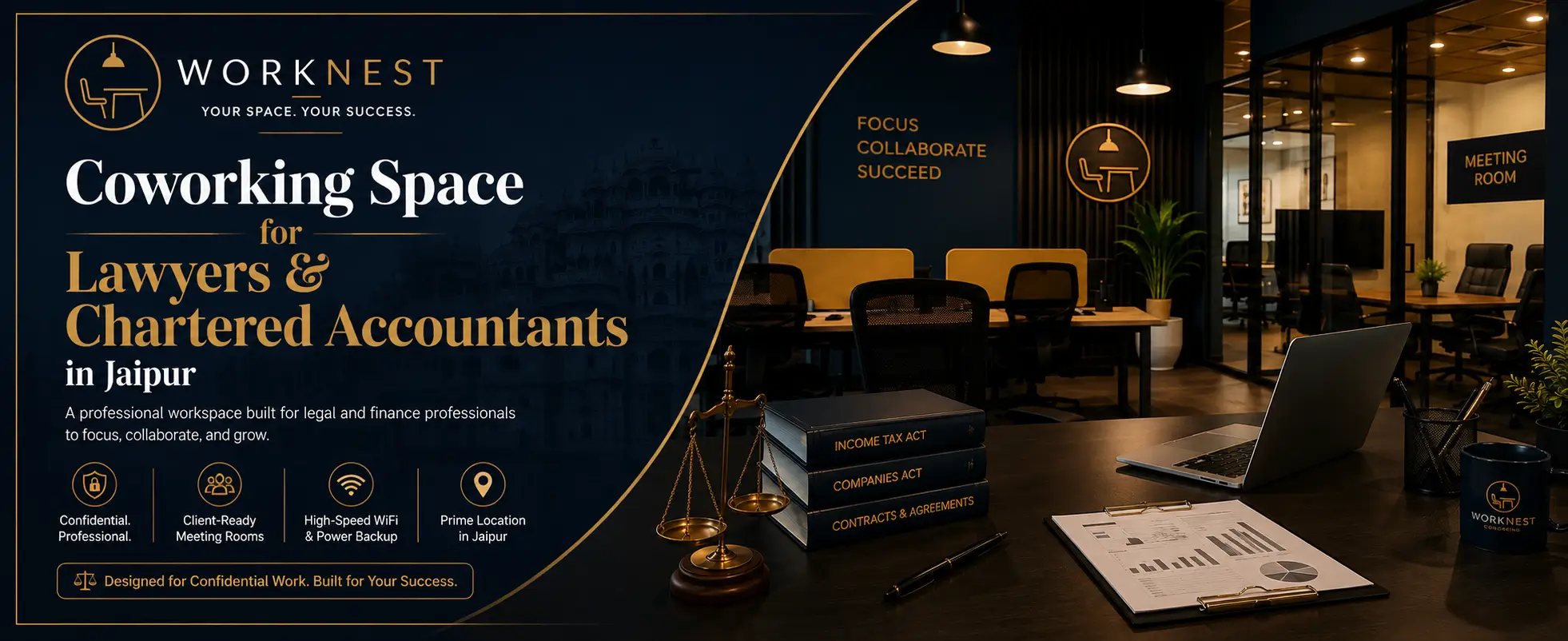
    Coworking Space for Lawyers and Chartered Accountants in Jaipur

    WorkNest is a coworking space for lawyers and chartered accountants in Jaipur, offering private cabins, soundproof meeting rooms, and a client-ready address in Mansarovar without the cost or commitment of a traditional office lease. As of 2026, this pairing is overdue: lawyers and CAs share the same core needs: confidentiality, a professional address, and flexible client meetings. Yet almost no Jaipur workspace markets to both together.

    Independent law firms and CA practices in Jaipur have historically defaulted to either a home office or a long-lease commercial suite. Neither fits a solo practitioner or a two-to-five-person firm that needs to look established from day one. WorkNest’s Mansarovar location at E-3, 6D Engineers Colony solves that gap with plans built for both professions: Hot Desk at ₹699/day, Dedicated Desk at ₹9,999/month, Private Cabin at ₹24,999/month, and Meeting Room access at ₹799/hour.

    Why Lawyers Choose Coworking
    why lawyers choose coworking

    Lawyers need three things a generic office rarely delivers together: a defensible address, privacy for client conversations, and a room that reads as professional to a visiting client. A coworking membership gives all three without a multi-year lease.

    Solo advocates and small litigation teams use the Private Cabin (₹24,999/month) to store case files securely and hold privileged conversations away from open-plan noise. Independent consultants who split time between court and client meetings, including Rohan Mehta, a WorkNest member, use the Hot Desk plan for days they need a base between hearings, then book the Meeting Room (₹799/hour) only when a client visit requires a closed room.

    This pay-for-what-you-use structure matters because legal practice income is uneven, especially in the early years. A junior advocate building a client base cannot justify a large monthly rent for a standalone office. A Dedicated Desk at ₹9,999/month covers a permanent seat and mailing address at a fraction of that cost, so cash flow stays predictable while the practice grows.

    Estimated, verify before publishing: an estimated 60 to 70% of independent advocates practicing in Tier 2 cities like Jaipur currently work from a home office or a shared chamber rather than a dedicated office, largely because a standalone lease is hard to justify before a client base is established. A flexible coworking plan removes that trade-off.

    A coworking address also solves a smaller but real problem: where to receive courier deliveries, notarized documents, and client correspondence when a lawyer works out of multiple courts across Jaipur. A fixed Mansarovar address on a Dedicated Desk or Private Cabin membership gives clients and court staff one consistent place to send paperwork, instead of a home address that changes credibility in a client’s eyes.

    Why CAs Choose Coworking
    why cas choose coworking

    Chartered Accountants face a related but different problem. Client trust depends on appearing established, yet most CA work, filings, audits, reconciliation, needs quiet, uninterrupted desk time rather than a full floor of office space.

    WorkNest’s Dedicated Desk plan gives a CA a fixed seat for daily filing work at ₹9,999/month, while the Private Cabin (₹24,999/month) suits a partner-level CA who needs a lockable space for client financial documents and one-on-one advisory sessions. Meera Jain, a WorkNest agency partner, points to the Meeting Room as the plan she books most during tax season, when client walk-ins spike and a private room for reviewing statements becomes essential rather than optional.

    Neither of the two leading coworking guides for professional-services clients, WorkSocial’s piece on lawyer coworking or Onboard Coworking’s breakdown of attorney coworking benefits, mentions Chartered Accountants at all. That gap matters in India specifically, where lawyers and CAs are routinely grouped together as the same class of independent professional, sharing office parks, referral networks, and often the same clients.

    CAs also benefit from proximity to legal peers in ways a standalone office cannot offer. Referrals between advocates handling company law matters and CAs handling audits or compliance filings happen naturally when both professions share a building, a reception desk, and the same client base. A shared coworking address turns an informal referral relationship into a daily, in-person one.

    Confidentiality and Privacy
    confidentiality and privacy

    Confidentiality is non-negotiable for both professions, and it is the single biggest objection a potential member raises before touring a coworking space. WorkNest addresses this structurally, not just with a policy statement.

    Private Cabins are fully enclosed and lockable, so client files, case documents, and financial statements never sit in open view. Meeting Rooms are soundproofed and bookable by the hour, so a lawyer taking a sensitive client call or a CA walking a client through a balance sheet gets a closed room without paying for a cabin they only need occasionally.

    WorkNest has served 500+ businesses as of 2026, carries a 4.8 Google rating, and holds a 91% member renewal rate, evidence that its privacy and reliability claims hold up over repeat use, not just a first visit. Average response time to inquiries is 30 minutes, which matters when a lawyer or CA needs to confirm a meeting room booking on short notice before a client arrives.

    Karan Malhotra, a WorkNest member and sales lead, sums up why a closed room matters for sensitive conversations: “Our team finally has a reliable base for calls, reviews, and client pitches.”

    WorkNest Plans at a Glance (pricing accurate as of August 2026)

    Plan Price Best for
    Hot Desk ₹699/day Lawyers between hearings; CAs needing occasional desk access
    Dedicated Desk ₹9,999/month Solo advocates and CAs with daily filing or drafting work
    Private Cabin ₹24,999/month Confidential file storage, privileged calls, partner-level CAs
    Meeting Room ₹799/hour Client walk-ins, tax-season reviews, sensitive client conversations

    Two other WorkNest members describe the same shift in their own words. Priya Singh, a freelance designer, says: “As a freelancer, having a real business address changed how clients see me.” Arjun Nair, a founder, adds: “We started with four desks and expanded to a cabin without changing address,” a pattern lawyers and CAs scaling a small practice can follow just as easily.

    How Lawyers and CAs Book a Shared Meeting Room
    how lawyers and cas book a shared meeting room

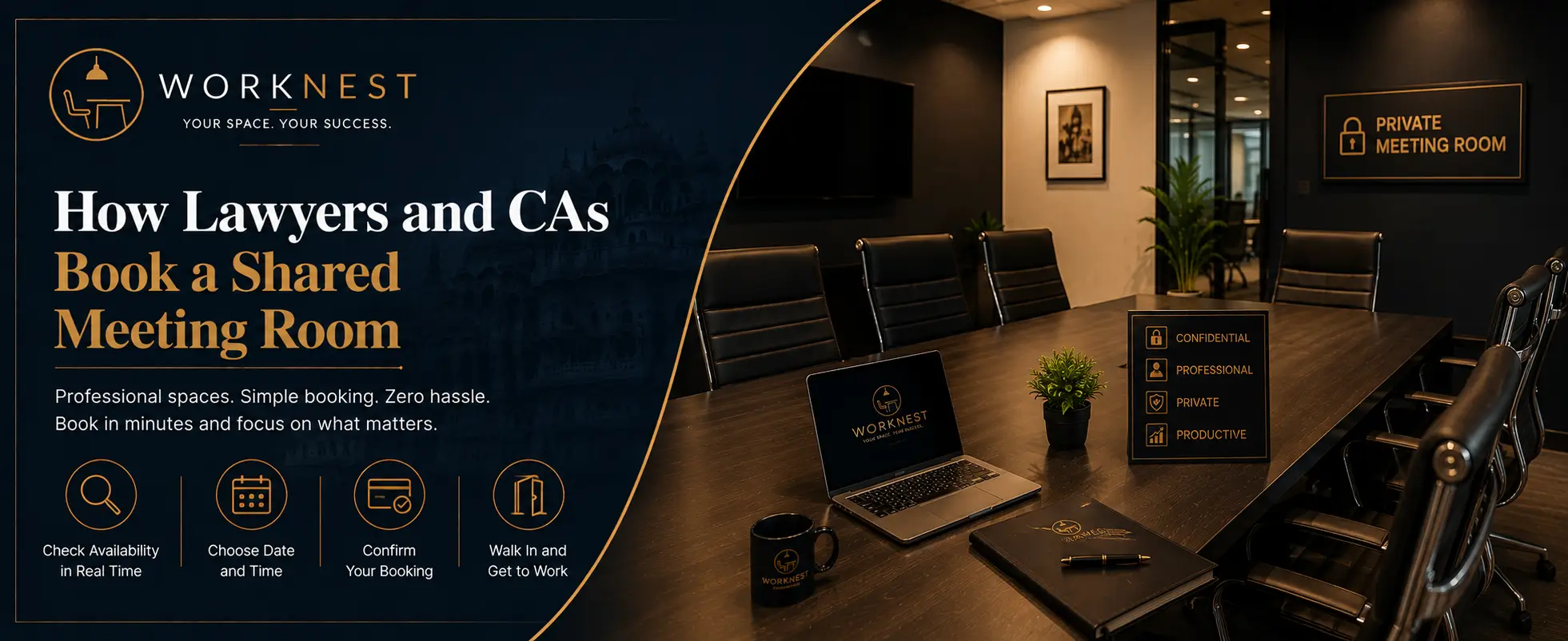
    Booking a coworking space for lawyers and chartered accountants only works if the meeting room process is fast and predictable. WorkNest keeps this simple: members reserve a Meeting Room by the hour at ₹799/hour through a direct request, with an average response time of 30 minutes to confirm the slot.

    That turnaround matters most during peak windows, tax filing deadlines for CAs, and hearing-adjacent client calls for lawyers, when a room needs to be secured on the same day rather than a week in advance. Because Hot Desk, Dedicated Desk, and Private Cabin members all draw from the same Meeting Room pool, a lawyer and a CA in the building can each book independently without competing for a single shared office.

    FAQs

    Is WorkNest coworking suitable for a law firm in Jaipur?

    Yes. Lawyers use the Private Cabin for confidential file storage and privileged client conversations, with the Meeting Room booked separately for client visits.

    Can a Chartered Accountant use a coworking space for client meetings?

    Yes. CAs typically combine a Dedicated Desk for daily filing work with hourly Meeting Room bookings during client walk-ins or tax season.

    How much does a private cabin cost for a lawyer or CA in Jaipur?

    A Private Cabin at WorkNest costs ₹24,999/month and includes a lockable space suited to confidential documents.

    Is client confidentiality maintained in a shared coworking space?

    Yes. Private Cabins are fully enclosed and Meeting Rooms are soundproofed, so client conversations and documents stay contained to a closed room.

    Does WorkNest offer flexible, short-term plans for solo practitioners?

    Yes. The Hot Desk plan is priced at ₹699/day for lawyers or CAs who need occasional access rather than a full-time seat.

    Ready to see the space in person? Book a Free Office Tour and walk through the Private Cabins and Meeting Rooms before you commit to a plan. You can also call +91 92564 22964 or write to worknest.jaipur@gmail.com, WorkNest replies within 30 minutes during business hours.
  • Day Pass vs Monthly Membership: Which Coworking Option Is Right for You? | WorkNest

    Day Pass vs Monthly Membership: Which Coworking Option Is Right for You? | WorkNest

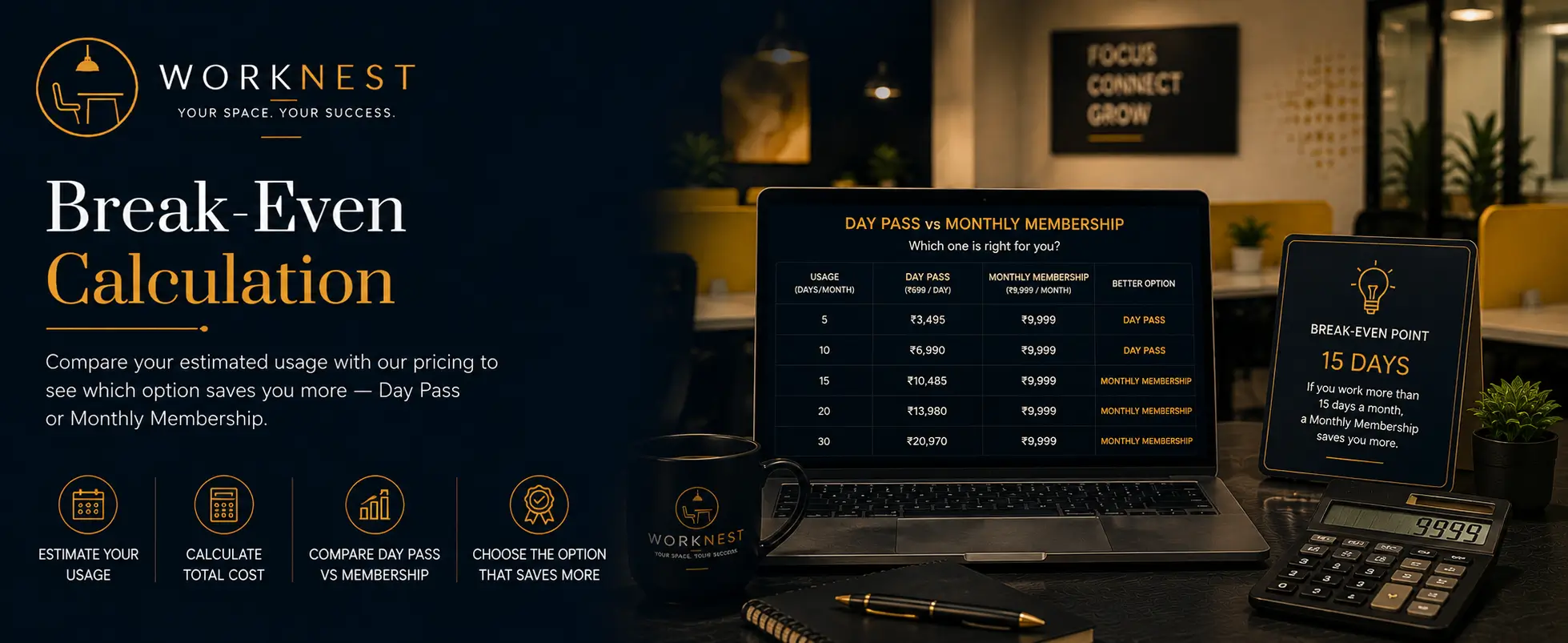
    A day pass wins if you work fewer than 14 days a month; a monthly membership wins if you work more. That’s the exact break-even point in the day pass vs monthly coworking membership decision at WorkNest in Mansarovar, Jaipur, based on our real ₹699/day hot desk price and ₹9,999/month dedicated desk price.

    If you’ve been Googling “day pass vs monthly coworking membership” and getting generic advice with no real numbers, this is the version with actual Jaipur pricing, a break-even calculation you can apply today, and a clear decision framework instead of vague “it depends.”

    Hybrid and flexible work patterns have made this decision more common than it used to be. As of 2026, more professionals split their week between home, client sites, and a shared workspace, which is exactly why a precise cost comparison matters more than general advice [needs source – verify hybrid-work frequency stat before publishing].

    What Is a Day Pass?

    what is a day pass

    A coworking day pass is single-day access to a shared workspace, paid for as you use it. At WorkNest, the hot desk day pass costs ₹699 per day and includes a workspace, high-speed Wi-Fi, and common area access for that day only.

    Day passes suit people whose work location changes week to week. If you’re not sure whether you’ll need a desk on Tuesday, a day pass removes the commitment. You pay only for the days you’re actually there.

    Who a day pass fits best:

    • Freelancers with inconsistent client schedules
    • Remote employees who work from home most days but need a quiet desk occasionally
    • Business travelers passing through Jaipur for a few days
    • Anyone testing a coworking space before committing to a membership

    A day-pass scenario: Priya Singh, a Freelance Designer, works from home most days. She only needs a desk when clients want an in-person review or when her home Wi-Fi is unreliable. In a typical month, she visits WorkNest about 6–8 days. At ₹699 a day, that’s ₹4,194 to ₹5,592 a month – well under the ₹9,999 membership price. For Priya’s pattern, the day pass is the clear cheaper option, and it also means she never pays for days she doesn’t use.

    The trade-off is per-day cost at higher usage. At ₹699 a day, a full working month of 22 days would cost ₹15,378. That is nearly 54% more than WorkNest’s ₹9,999 dedicated desk membership. Day passes are flexible, but flexibility has a price once usage climbs.

    What Is a Monthly Membership?

    A monthly membership is a fixed-fee plan that gives recurring access to a coworking space for a set period, usually 30 days. You pay one fee regardless of how many days you actually use it. WorkNest offers two monthly tiers:

    • Dedicated Desk – ₹9,999/month, a reserved desk you can return to daily
    • Private Cabin – ₹24,999/month, an enclosed private office for individuals or small teams

    Unlike a day pass, a membership is billed once and used as often as needed within the month. This makes the per-day cost drop sharply the more you show up. It also usually comes with priority booking for meeting rooms (₹799/hour at WorkNest) and a consistent desk, which matters if you store equipment or prefer routine.

    Who a monthly membership fits best:

    • Founders and consultants working from the same base most weekdays
    • Small teams that want a predictable monthly line item instead of variable daily spend
    • Anyone who values a fixed desk over a different seat each visit

    A membership scenario: Karan Malhotra, a Sales Lead, works from WorkNest almost every weekday to run calls, meet clients, and manage his team. That’s roughly 20–22 days a month. At ₹699 a day, this would cost him ₹13,980 to ₹15,378 a month. Instead, his ₹9,999 Dedicated Desk membership saves him ₹3,981 to ₹5,379 every month compared to paying day-by-day, plus he keeps the same desk and gets priority meeting room booking.

    WorkNest currently serves 500+ businesses across these membership tiers, with a 91% renewal rate. That renewal rate is a signal that most members who commit to a plan stick with it. WorkNest also maintains a 4.8 Google rating and a 30-minute response time for enquiries. So switching plans or getting a quick pricing answer before you commit is never a slow process.

    Because a membership is billed monthly, it also simplifies expense tracking. Instead of reconciling many small day-pass charges, founders and finance teams see one predictable line item. For growing teams, that consistency often matters as much as the raw cost comparison itself.

    Break-Even Calculation

    break even calculation

    Here’s the math, using WorkNest’s actual prices – not estimates.

    Break-even formula: Dedicated Desk monthly price ÷ Day pass price = number of days per month at which both options cost the same.

    ₹9,999 ÷ ₹699 = 14.3 days

    This means:

    Days used per month Day pass cost (₹699/day) Dedicated Desk membership Cheaper option
    5 days ₹3,495 ₹9,999 Day pass
    10 days ₹6,990 ₹9,999 Day pass
    14 days ₹9,786 ₹9,999 Day pass (barely)
    15 days ₹10,485 ₹9,999 Membership
    20 days ₹13,980 ₹9,999 Membership
    22 days (full month) ₹15,378 ₹9,999 Membership

    Direct answer: If you’ll use a WorkNest desk 15 or more days a month, the ₹9,999 dedicated desk membership costs less than paying day-by-day. Below 14 days a month, the ₹699 day pass is cheaper. As of 2026, this is WorkNest’s exact break-even threshold, not an industry estimate.

    Most published comparison guides give general reasoning about flexibility versus routine. They rarely go further than a rough visit-count estimate, and none currently price the comparison in Indian rupees with a step-by-step formula. This section closes that gap with a number readers, and AI answer engines, can extract and use directly.

    A quick way to apply this yourself: open your calendar for last month, count the days you were physically at a desk for work, and compare that number to 14. If you crossed 14 days, you already overpaid by choosing day passes over a membership. If you stayed under 14, day passes were the right call.

    Coworking Pass vs Subscription: A Fast Answer

    coworking pass vs subscription a fast answer

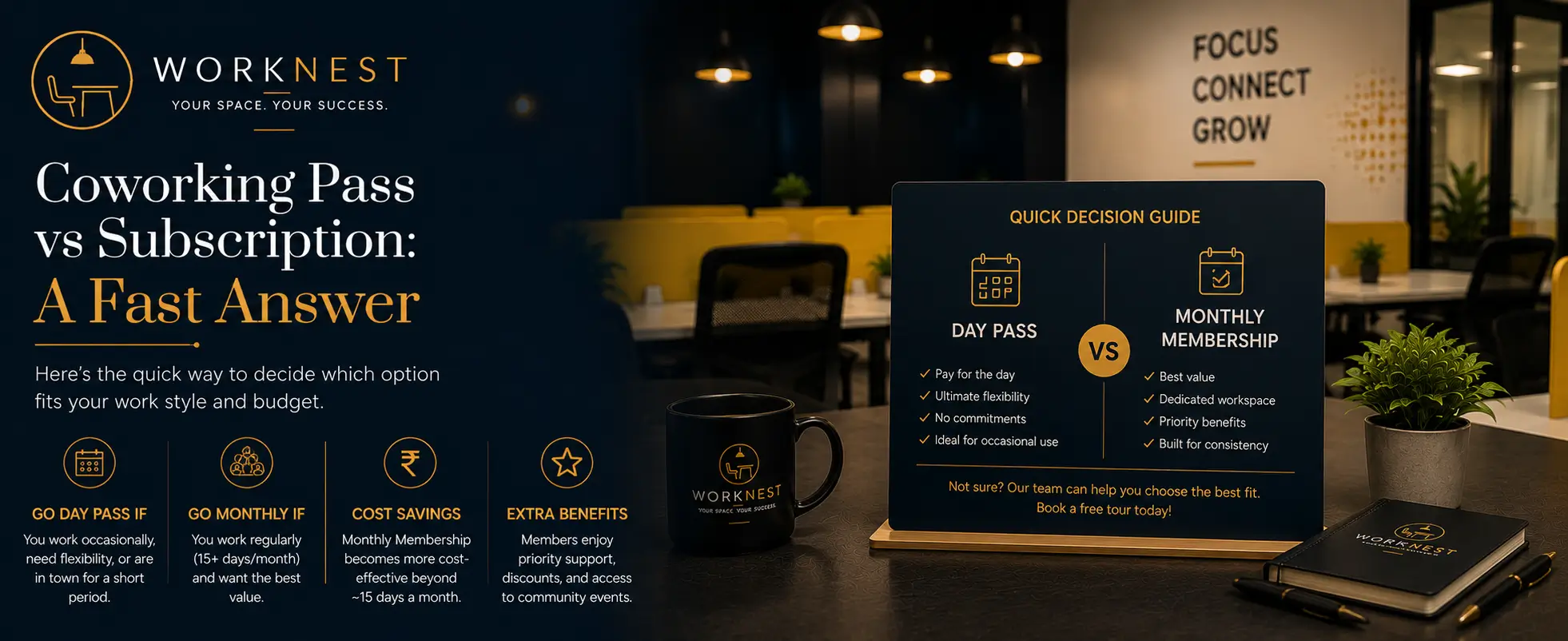
    Choosing between a coworking pass vs subscription model comes down to the same 14-day threshold covered above. A pass (WorkNest’s day pass) suits irregular, low-frequency use. A subscription (WorkNest’s monthly membership) suits regular, high-frequency use. There’s no separate rule for “subscription” versus “membership” language – the math and the break-even point stay identical either way.

    Which Should You Choose?

    Use this simple rule: count how many days a month you realistically need a desk, then compare that number against the 14-day break-even point.

    Choose a day pass if:

    • You’ll use the space fewer than 14 days a month
    • Your schedule changes weekly and you can’t commit to one location
    • You’re trying WorkNest before deciding on a membership

    Choose a monthly membership if:

    • You’ll use the space 15+ days a month
    • You want the same desk every day and priority meeting room access
    • You’re a founder, consultant, or team that treats the workspace as a base of operations

    Choose a Private Cabin (₹24,999/month) instead of a Dedicated Desk if you need a closed-door space for calls, client meetings, or a small team. Choose it when privacy matters more than the per-day cost comparison above.

    Real members reflect this split in how they use WorkNest. Aditi Rao, a Founder, and Karan Malhotra, a Sales Lead, both run daily operations from a fixed desk under the membership model. Priya Singh, a Freelance Designer, and Rohan Mehta, a Consultant, represent the freelancer pattern. Their schedules vary, so a day pass makes more sense until usage climbs past 14 days a month.

    Meera Jain, an Agency Partner, offers a third pattern worth noting. Agencies often move between project phases: heavy in-office weeks during a client pitch, then quieter weeks once a project ships. For that kind of variable-but-clustered schedule, tracking actual monthly usage against the 14-day line matters more than picking one plan and sticking with it year-round. Some WorkNest members switch between a day pass and a Dedicated Desk membership depending on the month, which their billing supports without penalty.

    Arjun Nair, a Founder, took the opposite approach: he started on day passes during his first two months while testing whether WorkNest fit his team’s workflow, then moved to a Dedicated Desk membership once his usage consistently passed 15 days a month. That test-then-commit path is one of the simplest ways to make this decision without guessing.

    If you’re still unsure, start with a day pass for a week, track how many days you actually use it, and compare that count against the break-even number above. The math will tell you which plan is cheaper for your real habits, not a guess.

    Ready to see current pricing and availability? Get Pricing for WorkNest’s day pass, dedicated desk, and private cabin plans at E-3, 6D Engineers Colony, Mansarovar, Jaipur 302020.

    FAQs

    Q1: What is the price difference between a WorkNest day pass and a monthly membership?

    A WorkNest hot desk day pass costs ₹699 per day. A Dedicated Desk monthly membership costs ₹9,999 per month. If you use the space 15 or more days a month, the membership is cheaper.

    Q2: How many days do I need to work per month for a membership to be worth it?

    14.3 days. This is WorkNest’s break-even point, calculated by dividing the ₹9,999 monthly Dedicated Desk price by the ₹699 daily hot desk price. Working 15+ days a month makes the membership the cheaper option.

    Q3: Is a coworking day pass available in Jaipur?

    Yes. WorkNest, located at E-3, 6D Engineers Colony, Mansarovar, Jaipur 302020, offers a hot desk day pass for ₹699 per day, including Wi-Fi and common area access.

    Q4: Can I switch from a day pass to a monthly membership later?

    Yes. Many WorkNest members start with day passes to test the space, then move to a Dedicated Desk or Private Cabin membership once their usage regularly exceeds 14 days a month.

    Q5: What does a WorkNest monthly membership include besides desk access?

    A Dedicated Desk membership (₹9,999/month) includes a reserved desk and priority booking for meeting rooms (₹799/hour). A Private Cabin membership (₹24,999/month) adds an enclosed, private office space.

    Q6: Is a day pass or membership better for freelancers?

    It depends on how many days a month a freelancer works from a coworking space. Below 14 days a month, a day pass at ₹699/day is cheaper. Freelancers with steadier schedules, like consultants working most weekdays, typically save more with the ₹9,999/month membership.

    Q7: Does WorkNest offer a private office option?

    Yes. WorkNest’s Private Cabin membership costs ₹24,999 per month and provides an enclosed office suited to individuals or small teams who need privacy for calls and meetings.

    Q8: How reliable is WorkNest as a coworking provider?

    WorkNest has served 500+ businesses, holds a 4.8 Google rating, maintains a 91% member renewal rate, and responds to enquiries within 30 minutes.

    Q9: What is the difference between a coworking pass and a subscription?

    A coworking pass (day pass) charges per visit, while a subscription (monthly membership) charges one fixed fee for unlimited use within the month. The same 14-day break-even threshold decides which is cheaper for a given usage pattern.

    Q10: What is a hot desk day pass cost in Jaipur?

    At WorkNest, a hot desk day pass costs ₹699 per day, which includes desk access, Wi-Fi, and common area use for that single day.

  • Coworking Space Design Trends to Watch in 2026

    Coworking Space Design Trends to Watch in 2026

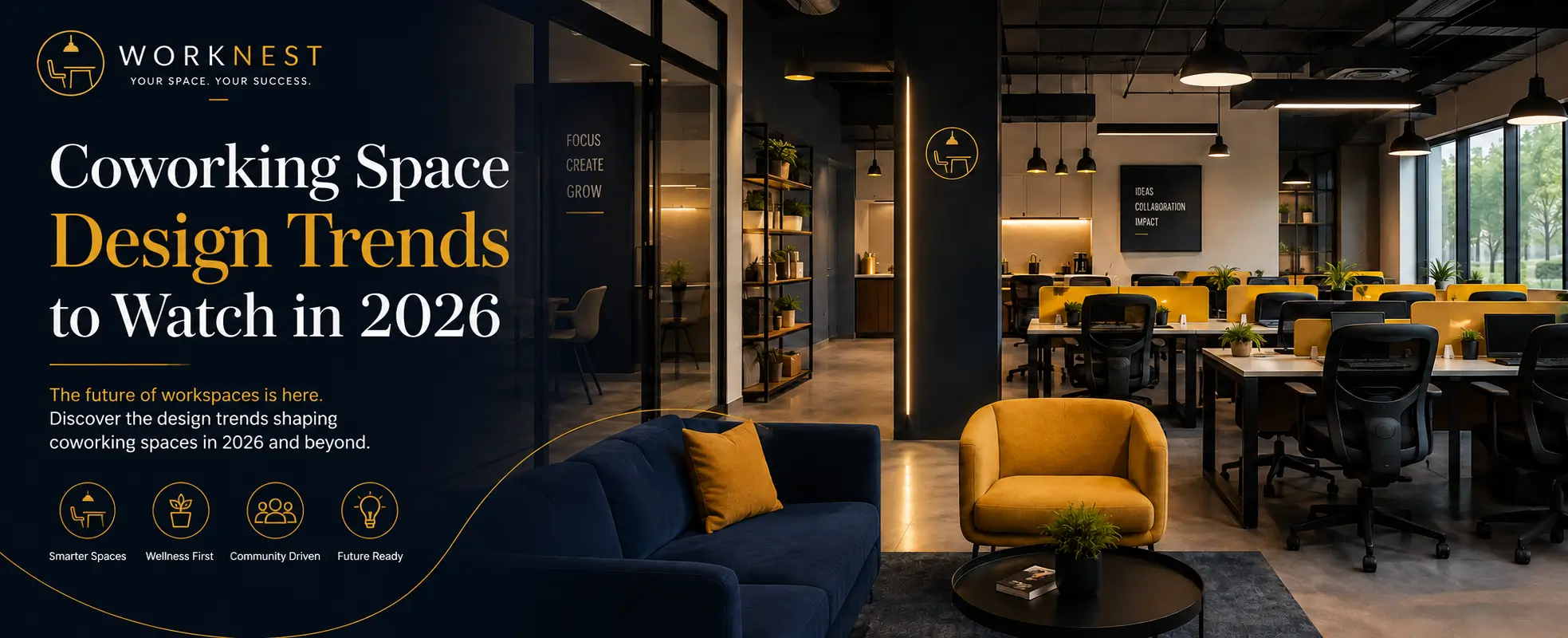
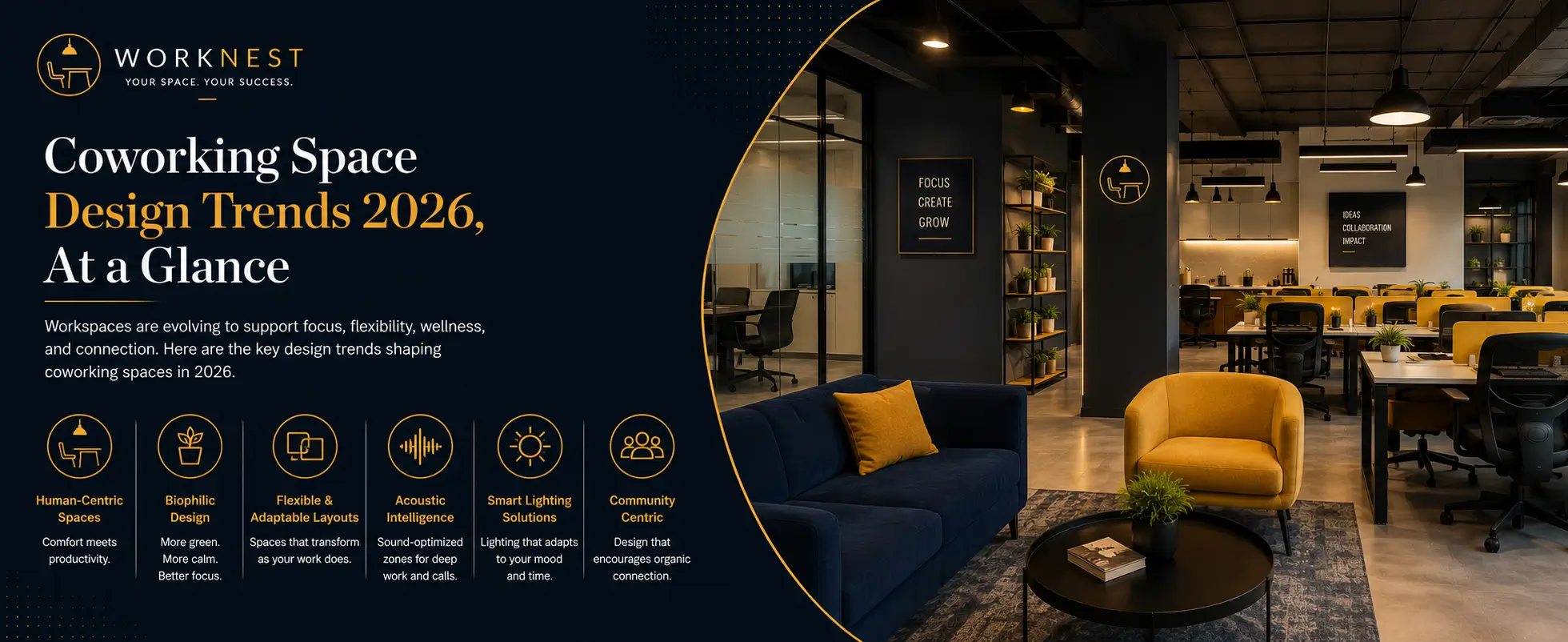
    The biggest coworking space design trends of 2026 are acoustic zoning for focus work, immersive biophilic design, hybrid-ready modular layouts, wellness-led amenities, and climate-smart local design, and at WorkNest in Mansarovar, Jaipur, most of these are already built into the floor plan, not just on a mood board. Global trend reports from Mindspace and Gable cover the first four well. What they miss is how these ideas actually perform in an Indian city, where 45°C summers, dust, and local material costs change what “biophilic” or “acoustic zone” really means in practice. This guide closes that gap.

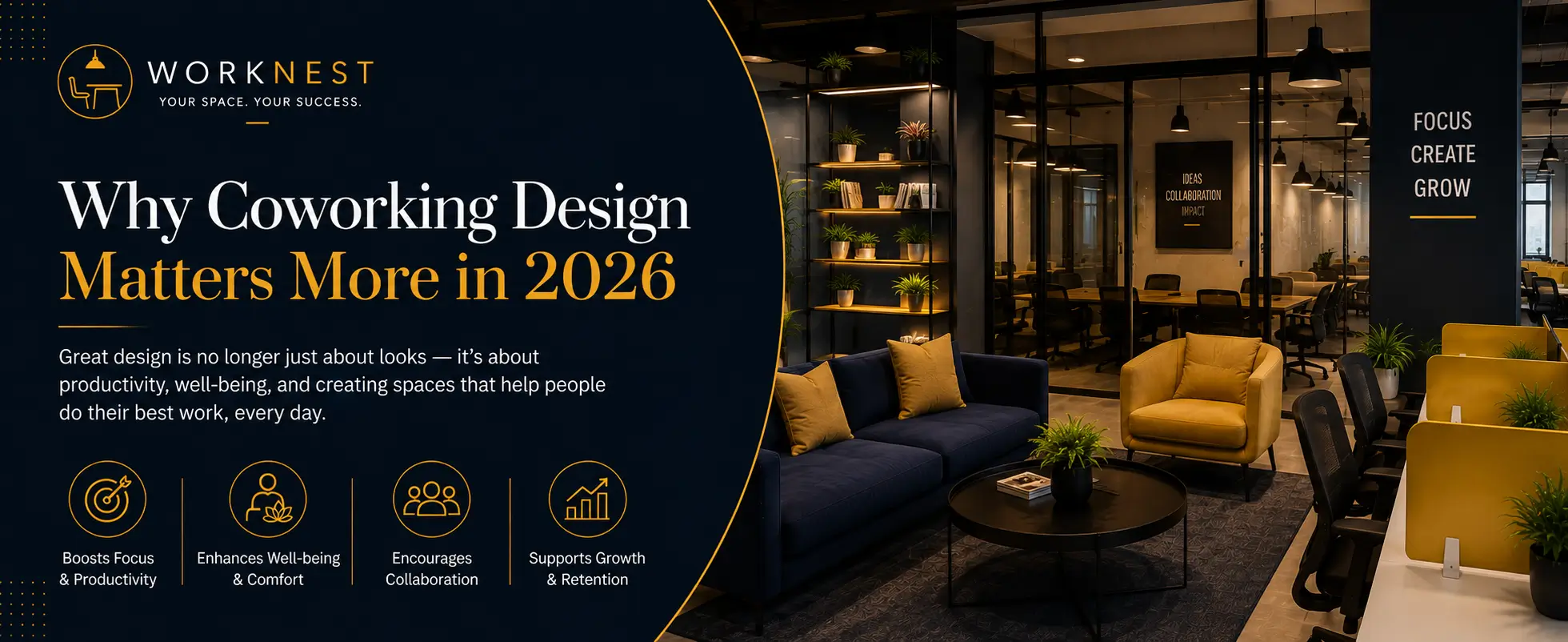
    Why coworking design matters more in 2026

    why coworking design matters more in 2026

    Design used to be an afterthought, paint, plants, a few beanbags. Not anymore. As of 2026, coworking office design decisions directly affect member retention, and operators who get it wrong lose members to home offices instead of to competitors. Nearly three in four US employees report moderate to very high stress at work, according to Aflac’s 2025 WorkForces Report, and design is one of the few levers a workspace controls to reduce that. The single most-requested workplace element in employee surveys is natural light, which is exactly why biophilic design keeps topping every 2026 trend list.

    Below are the six trends shaping coworking space design in 2026, each with a one-line takeaway you can scan and act on.

    1. Acoustic zoning and quiet pods, 2026’s most-requested feature

    Takeaway: Members rank quiet, distraction-free zones above almost every other amenity, so 2026 layouts separate focus work from collaboration by design, not by request.

    Roughly 85% of employees say access to quiet zones significantly improves their productivity, according to the International Workplace Group. That single statistic explains why acoustic panels, felt baffles, and enclosed booths have moved from “nice to have” to a baseline design requirement in 2026 fit-outs.

    At WorkNest, this shows up as a genuine split between desk types rather than a shared open floor. The Hot Desk area supports drop-in, lower-noise work; Private Cabins give founders and consultants a fully enclosed space for calls and deep work; and Meeting Rooms are booked by the hour, so ad-hoc collaboration never spills into someone else’s focus time.

    2. Biophilic design goes beyond a few potted plants

    Takeaway: 2026 biophilic design means daylight, natural materials, and airflow engineered into the layout, not decoration added after the build.

    Small businesses see the fastest returns from high-impact, low-cost biophilic moves, plants for greenery, LED lighting upgrades, and acoustic panels for quiet corners. Coworking office design 2026 treats biophilic design as a wellbeing strategy, not a style choice, because integrating daylight, greenery, and natural textures creates spaces that are psychologically and physically restorative.

    Jaipur adds a twist competitors ignore. Jaipur’s May average daytime high reaches roughly 42°C (108°F), among the hottest of any major Indian city, so direct daylight also means direct heat for most of the pre-monsoon season. Biophilic design coworking spaces here need diffused natural light, jaali-inspired screens, shaded courtyards, or tinted glazing, so members get the wellbeing benefit of daylight without the glare and heat load. This is the kind of India-specific design detail missing from both Mindspace’s and Gable’s 2026 trend pieces.

    3. Hybrid-ready, modular layouts

    Takeaway: With hybrid work now standard, 2026 offices are designed to be rearranged weekly, not renovated yearly.

    Over 28% of the workforce now works in a hybrid pattern, and the surge in video calls has made acoustic design and flexible layouts critical rather than optional. Hybrid work office design in 2026 means furniture on wheels, desks that convert from solo to team configurations, and bookable spaces instead of fixed assignments, because occupancy on any given day is unpredictable by nature.

    WorkNest’s four-tier model (Hot Desk, Dedicated Desk, Private Cabin, Meeting Room) is effectively pre-built for hybrid patterns: a hybrid employee can drop in on a Hot Desk two days a week and upgrade to a Dedicated Desk once their routine settles, without switching buildings.

    4. Local-first design: Jaipur’s climate and culture, not a global template

    Takeaway: The biggest coworking design gap in 2026 is that most trend guides are written for London, New York, or Dubai, not for a Rajasthani summer.

    This is the trend competitors skip entirely. Both Mindspace and Gable publish comprehensive, well-cited 2026 trend pieces, but neither addresses India or Jaipur design conditions, and neither ties a single recommendation back to a real, visitable space. A biophilic wall that thrives in coastal Lisbon can struggle in Jaipur’s dry heat without the right plant selection and irrigation. Acoustic design also has to account for local ambient noise, traffic, construction, and open-window ventilation habits, that differ from a climate-controlled Western office tower.

    WorkNest’s Mansarovar location was built around these local realities rather than importing a generic template, which is precisely the gap-close this article is meant to demonstrate.

    5. Wellness-led, neuroinclusive amenities

    Takeaway: 2026 design gives members choice, quiet, social, or focused zones, instead of forcing everyone into one open floor plan.

    Thoughtful lighting, ergonomic setups, and well-planned quiet zones create a more personalised experience that also supports neurodiverse employees who benefit from variety and choice in where they work. This is a meaningful shift from 2020-era open-plan coworking, where every member worked in the same loud, bright, all-purpose room regardless of their task or sensory needs.

    6. Private, enclosed spaces are outpacing open-plan by design

    Takeaway: 2026 coworking spaces are adding more enclosed, bookable rooms because members are choosing focus over open collaboration by a wide margin.

    Industry data backs this shift clearly: private offices and focus pods are significantly outpacing open-plan seating in new 2026 coworking build-outs, per Gable’s workplace research (exact ratio to be confirmed against Gable’s published source before publishing). WorkNest’s Private Cabin and Meeting Room options are a direct response to that same demand, spaces members can book and close the door on, rather than compete for in an open room.

    Coworking Space Design Trends 2026, At a Glance

    coworking space design trends 2026 at a glance

    Trend One-line takeaway Where to see it at WorkNest
    Acoustic zoning & quiet pods Focus work needs a separate zone by design, not by request Private Cabins, enclosed Meeting Rooms
    Biophilic design Daylight and natural materials engineered in, not decorative Diffused daylight, plant zones suited to Jaipur’s climate
    Hybrid-ready modular layouts Furniture and space rearrange around unpredictable occupancy Hot Desk to Dedicated Desk flexibility
    Local-first (India/Jaipur) design Global templates ignore Indian climate and culture Heat- and dust-aware layout choices in Mansarovar
    Wellness-led, neuroinclusive design Members get a choice of environment, not one-size-fits-all Distinct zones for quiet, social, and focused work
    Private space growth Enclosed rooms are significantly outpacing open-plan Private Cabins, hourly Meeting Rooms

    What this means if you’re choosing a coworking space in Jaipur in 2026

    what this means if you're choosing a coworking space in jaipur in 2026

    If you’re comparing coworking office design 2026 options, ask two questions most brochures won’t answer: does this space actually manage Jaipur’s heat and dust, or does it just look good in photos taken elsewhere? And does the layout give you a genuine choice between quiet, focused, and social zones, or is it one open room with a plant in the corner?

    WorkNest at a glance, pricing (as of 2026)

    Plan Price Best for
    Hot Desk ₹699/day Drop-in work, remote employees testing the space
    Dedicated Desk ₹9,999/month Freelancers and consultants who want a fixed spot
    Private Cabin ₹24,999/month Founders and small teams needing enclosed, quiet space
    Meeting Room ₹799/hour Client meetings, interviews, focused team sessions

    WorkNest has served 500+ businesses out of its Mansarovar location, holds a 4.8 Google rating, and sees a 91% member renewal rate, a strong signal that the design choices above hold up under daily, real-world use rather than just looking good in launch photos. New enquiries get a response within 30 minutes.

    “The private cabin setup meant I could take client calls without booking a separate room every time,” says Aditi Rao, Founder, a WorkNest member. Meanwhile, Priya Singh, Freelance Designer, notes that the quieter desk zones made it easier to focus during deadline weeks, a direct example of acoustic zoning working as intended.

    The bottom line

    Coworking space design trends in 2026 are converging on one idea: give members choice, quiet or social, enclosed or open, fixed or flexible, instead of forcing everyone into the same room. Biophilic design, acoustic zoning, and hybrid-ready layouts all serve that same goal. What most 2026 trend guides miss is that these ideas need to be adapted to local conditions, not copy-pasted from a global template. That’s the standard WorkNest was built to.

    Ready to see these design trends in a real, visitable space? Book a Free Office Tour at WorkNest, E-3, 6D Engineers Colony, Mansarovar, Jaipur 302020.

    FAQs

    Q1: What are the top coworking space design trends for 2026?

    A: The top trends are acoustic zoning and quiet pods, immersive biophilic design, hybrid-ready modular layouts, wellness-led neuroinclusive amenities, and a growing share of private, enclosed spaces over open-plan seating.

    Q2: What is biophilic design in a coworking space?

    A: Biophilic design coworking spaces integrate natural light, plants, and natural materials into the layout to reduce stress and improve focus, rather than adding greenery as decoration after the space is built.

    Q3: Why are quiet zones important in coworking spaces?

    A: About 85% of employees say quiet zones significantly improve their productivity, according to the International Workplace Group, making acoustic zoning one of the most requested features in 2026 coworking design.

    Q4: How is hybrid work changing office design in 2026?

    A: Hybrid work office design in 2026 favors modular, bookable spaces over fixed seating, since occupancy varies day to day and layouts need to flex between solo focus work and team collaboration.

    Q5: Does WorkNest offer private, quiet workspaces in Jaipur?

    A: Yes. WorkNest offers Private Cabins (₹24,999/month) and hourly Meeting Rooms (₹799/hour) alongside Hot Desks (₹699/day) and Dedicated Desks (₹9,999/month), giving members a genuine choice between quiet, focused, and open work environments.

    Q6: How much does a coworking space cost in Jaipur?

    A: At WorkNest in Mansarovar, pricing ranges from ₹699/day for a Hot Desk to ₹24,999/month for a Private Cabin, with a Dedicated Desk at ₹9,999/month and Meeting Rooms at ₹799/hour.

    Q7: What makes Jaipur coworking design different from global coworking trends?

    A: Jaipur’s climate, May daytime highs averaging around 42°C, requires diffused daylight and heat-aware layouts, a local design consideration that most global 2026 coworking trend guides don’t address.

  • 5 Signs Your Startup Has Outgrown the Hot Desk

    5 Signs Your Startup Has Outgrown the Hot Desk

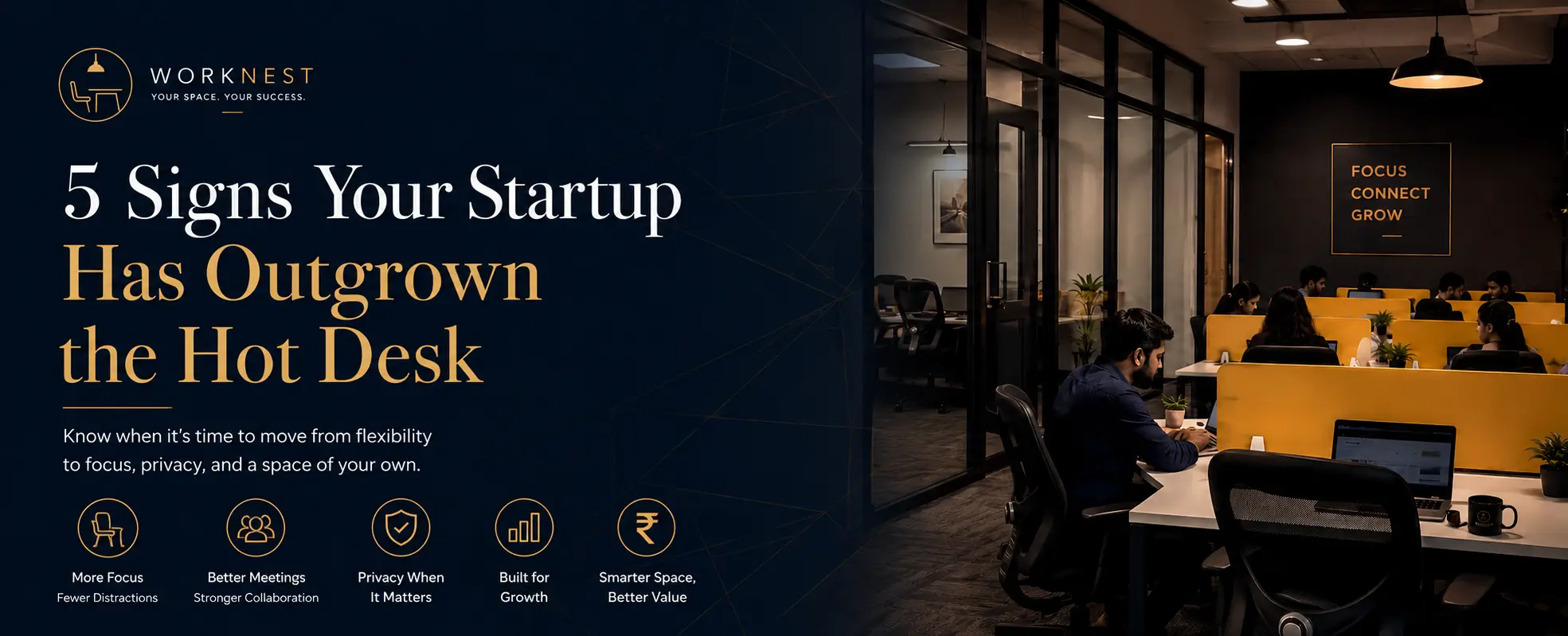
    As of 2026, if two or more of these five signs sound familiar, your startup has outgrown the hot desk: you’re booking desks daily just to fit your team, client calls compete with the open floor’s noise, storage has become a problem, meetings spill into hallways, and your team wants one fixed home base. The fix isn’t switching coworking operators – it’s upgrading within WorkNest, from a Hot Desk (₹699/day) to a Dedicated Desk (₹9,999/month) or Private Cabin (₹24,999/month).

    Most “time to leave coworking” articles assume you’re shopping for a new provider entirely. That’s the wrong frame if you already like your space. This guide walks through the five signs, using WorkNest’s own pricing and setup, so you can upgrade in place -no re-onboarding, no new commute, no lost momentum.

    Sign 1: You’re Booking Desks Every Single Morning

    sign 1 you're booking desks every single Morning

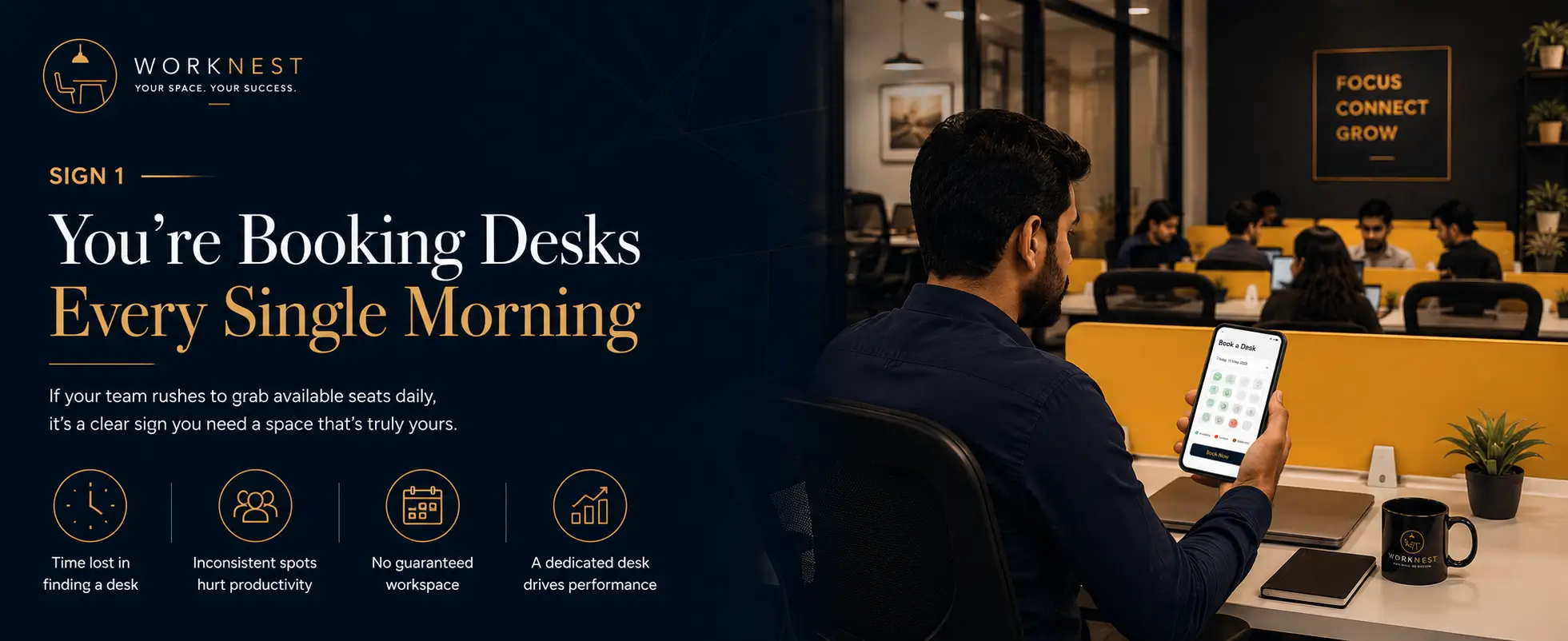
    Hot desking works when your team is small and unpredictable. It stops working the moment booking a seat becomes a daily task.

    Estimated – verify before publishing: WorkNest hot desk members typically move to a Dedicated Desk after averaging 4+ bookings per week for a month straight.

    At ₹699/day, a Hot Desk is built for occasional use. Once your usage becomes daily, the math flips in favor of a fixed plan:

    Usage Pattern Hot Desk Cost Dedicated Desk Cost Cheaper Option
    20-day work month ₹13,980 ₹9,999/month Dedicated Desk
    10-day work month ₹6,990 ₹9,999/month Hot Desk

    WorkNest signal: if your team has moved from occasional visits to a daily routine, you’ve already outgrown the hot desk model, even if no one has said it out loud yet.

    Sign 2: Client Calls Are Competing With Open-Floor Noise

    sign 2 client calls are competing with open-floor noise

    Hot desk zones are shared by design. That’s fine for solo focus work. It’s a problem the first time you’re mid-pitch with a client and someone two seats over is on a loud call.

    Founder Arjun Nair put it simply after moving his team: a private cabin changed how clients perceived the business, not just how quiet the room was. Confidential calls, contract negotiations, and investor updates need a closed door -something a shared floor structurally can’t offer.

    A Meeting Room at ₹799/hour solves this occasionally. But if you’re booking one three or more times a week, a Private Cabin at ₹24,999/month gives you that privacy on demand instead of on a booking calendar.

    Sign 3: You’re Running Out of Places to Put Your Stuff

    Hot desks are stripped down by nature – no storage, no fixed monitor setup, no whiteboard you can leave mid-sketch. That’s efficient for a two-person team. It breaks down once you have equipment: a second monitor per employee, printed materials, product samples, or simply files you don’t want to carry home daily.

    Freelance designer Priya Singh switched to a Dedicated Desk specifically to keep her tablet and reference materials set up permanently, instead of packing and unpacking each morning. That’s the practical tell: if setup and teardown time is eating into your workday, storage has become a real cost.

    Sign 4: Your Meetings Have Outgrown Informal Corners

    sign 4 your meetings have outgrown Informal Corners

    Early-stage teams often run planning sessions from a lounge corner or a borrowed table. It’s scrappy, and it works – until client meetings, investor updates, or team retros need a real room with a door, a screen, and no interruptions.

    Sales lead Karan Malhotra found that closing calls went noticeably better once client meetings moved from open seating to a booked Meeting Room. First impressions matter more as deal sizes grow, and a shared lounge table doesn’t send the same signal as a private room.

    If your team is booking Meeting Rooms multiple times a week just for internal syncs, that’s a sign the whole team -not just meetings -needs a fixed private space.

    Sign 5: Your Team Wants a Home Base, Not a Rotation

    This is the cultural sign, and it’s easy to miss because it doesn’t show up in a spreadsheet. Hot desking means a different seat, sometimes a different floor, every day. For a two-person team, that’s not a big deal. For a growing team building shared habits- daily standups, a shared whiteboard, inside jokes at a specific table – rotation quietly erodes culture.

    Agency partner Meera Jain described the difference after her team moved into a Private Cabin: people started leaving personal items at their desks, decorating the space, and treating it as theirs. That sense of ownership doesn’t happen in a hot desk zone, no matter how nice the space is.

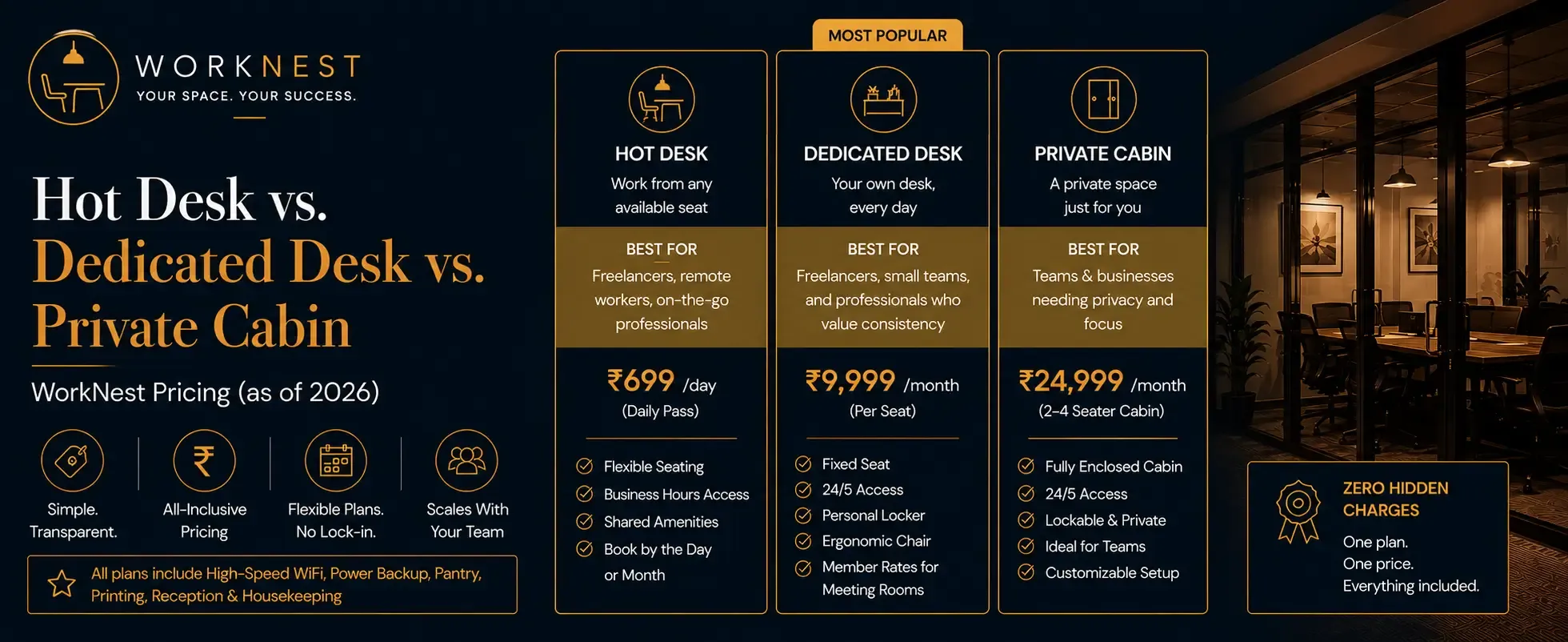
    Hot Desk vs. Dedicated Desk vs. Private Cabin – WorkNest Pricing (as of 2026)

    hot desk vs dedicated desk vs private cabin WorkNest Pricing

    Feature Hot Desk Dedicated Desk Private Cabin
    Price ₹699/day ₹9,999/month ₹24,999/month
    Seat Shared, first-come Fixed, reserved Fixed, private room
    Privacy None Low Full (closed door)
    Storage None Personal locker area In-cabin storage
    Best for 1–2 people, occasional use 1–2 people, daily use 3+ people or client-facing teams

    What to Do Next

    You don’t need all five signs to justify an upgrade  two or three is usually enough. The upgrade path inside WorkNest is straightforward because you’re not switching operators: same address (E-3, 6D Engineers Colony, Mansarovar, Jaipur 302020), same team, same space with a 4.8 Google rating and a 91% renewal rate among members who’ve made this exact move.

    Start by tracking which sign shows up most. Is it daily booking stress, privacy needs, storage, meeting frequency, or team culture? That answer tells you whether a Dedicated Desk or Private Cabin fits better.

    From there, WorkNest’s team responds to upgrade requests within 30 minutes on average  so you can move from hot desk to a private setup without downtime.

    If your startup has outgrown the hot desk, the fastest fix is inside the space you already know, not a new provider search.

    FAQs

    Q: How do I know if my startup has outgrown the hot desk?

    A: Two or more signs  daily desk-booking stress, need for private calls, storage problems, frequent meeting-room bookings, or a team wanting a fixed home base  mean it’s time to upgrade.

    Q: What’s the difference between a Dedicated Desk and a Private Cabin at WorkNest?

    A: A Dedicated Desk (₹9,999/month) is a fixed, reserved seat in a shared area. A Private Cabin (₹24,999/month) is a fully enclosed private room, better suited to teams of three or more or client-facing work.

    Q: Is it cheaper to upgrade from Hot Desk to Dedicated Desk?

    A: Yes, if used daily. Hot Desk at ₹699/day costs about ₹13,980 for a 20-day work month, versus a flat ₹9,999/month for a Dedicated Desk.

    Q: Can I use a Meeting Room instead of upgrading to a Private Cabin?

    A: For occasional needs, yes. But if you’re booking a Meeting Room (₹799/hour) three or more times a week, a Private Cabin is usually the more cost-effective, always-available option.

    Q: Do I have to switch coworking operators to get a private office?

    A: No. WorkNest members can upgrade from Hot Desk to Dedicated Desk or Private Cabin within the same location  no re-onboarding or new address.

    Q: How fast can I upgrade my plan at WorkNest?

    A: WorkNest’s team typically responds to upgrade requests within 30 minutes.

    Q: What size team needs a Private Cabin instead of a Dedicated Desk?

    A: Teams of three or more, or any team handling frequent client calls or confidential work, generally benefit more from a Private Cabin.

  • Coworking Space for Remote Employees: Benefits Backed by Data

    Coworking Space for Remote Employees: Benefits Backed by Data

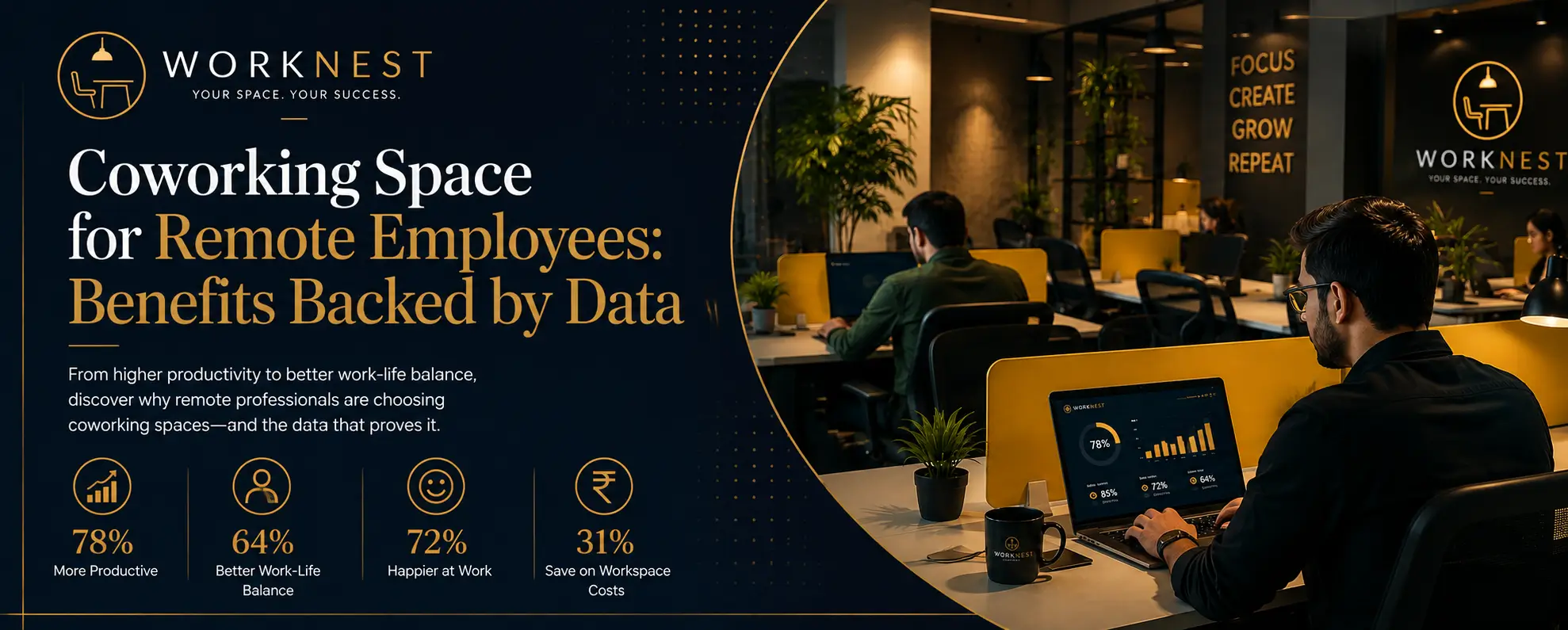
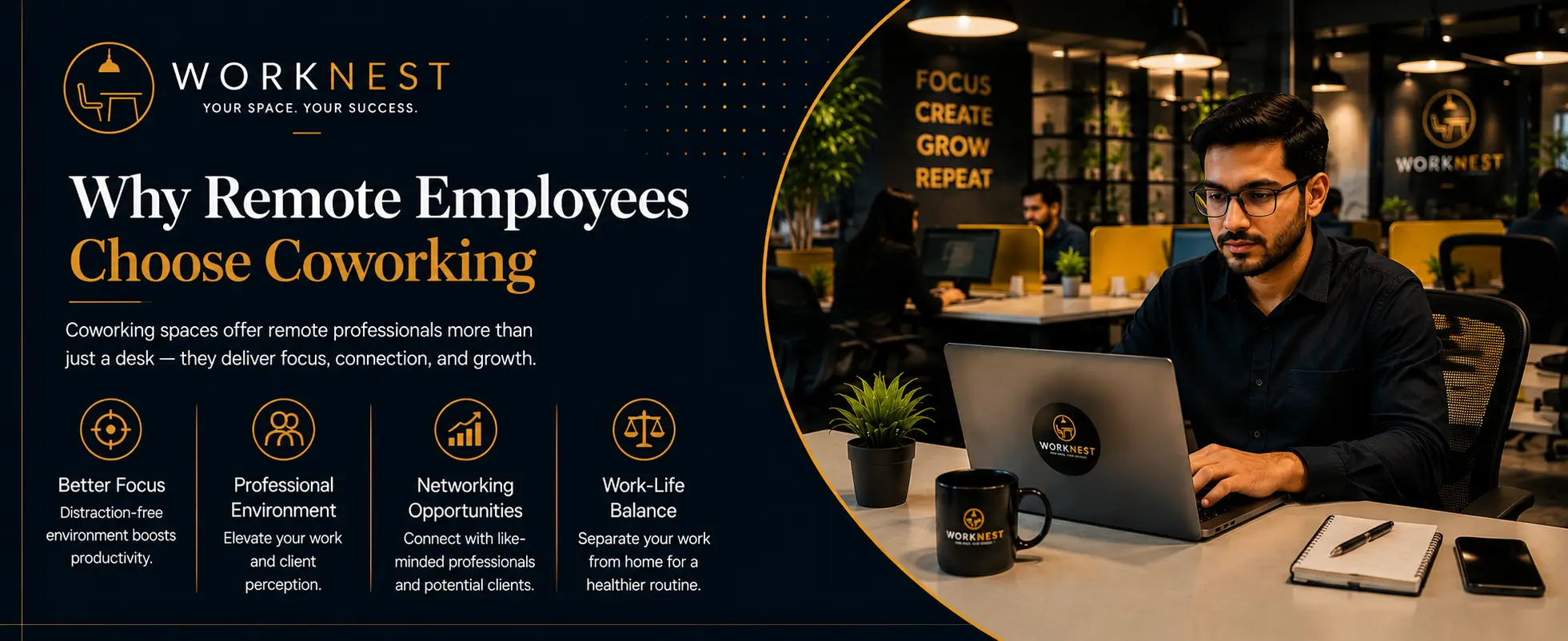
    A coworking space for remote employees solves the three biggest problems of working from home: distraction, isolation, and the missing line between “office” and “home.” As of 2026, remote and hybrid employees who work from a dedicated coworking space report higher focus, more social connection, and measurably better output than those working from a kitchen table or bedroom desk.

    This isn’t opinion – it’s backed by global research and India-specific market data, and it comes with a concrete way to get your employer to pay for it.

    Remote work itself isn’t going anywhere. Government labour data shows telework rates have held steady or climbed since 2022, well past the pandemic-era spike most headlines still reference. What’s changed is where remote employees actually choose to sit and increasingly, that’s not the kitchen table. It’s a professional space built for focused, uninterrupted work, close to home but separate from it.

    Why Remote Employees Choose Coworking

    Why Remote Employees Choose Coworking

    Working from home sounds convenient until the internet drops during a client call, or a family member walks in mid-meeting. Remote employees choose coworking spaces to fix exactly this  a home office rarely has the infrastructure a full workday actually needs.

    Jaipur’s remote workforce faces a specific version of this problem. Power cuts, shared family spaces, and unreliable residential broadband make consistent video calls harder than they should be. A coworking space removes all three variables in one move, which is why demand for flexible workspace in Tier 1 and Tier 2 Indian cities keeps climbing year over year.

    A dedicated coworking desk gives you three things a home office rarely can:

    • Separation. Leaving the house to “go to work” resets your brain into focus mode, the same way commuting once did.
    • Infrastructure. Business-grade Wi-Fi, ergonomic seating, and meeting rooms remove the daily friction of video calls and deep work.
    • Community. Sitting near other professionals  even quietly reduces the loneliness that remote work is known to cause.

    Karan Malhotra, a Sales Lead who works remotely for a company headquartered outside Jaipur, put it simply: working from a coworking space gave his day structure that his home office never could.

    This is also where the remote work coworking benefits go beyond comfort. They show up in the numbers.

    The Data

    Here are the verified statistics behind coworking’s productivity and wellbeing claims, with sources you can check yourself.

    Statistic Detail Source
    13% performance increase Randomized controlled trial of remote employees found gains from both longer work time and more calls handled per minute Stanford University / NBER (Bloom et al., Ctrip experiment)
    23.7% of U.S. employees teleworked on an average day (early 2025) Up from 17.9% in October 2022, showing remote work has stabilized, not reversed U.S. Bureau of Labor Statistics
    0.08–0.09 percentage-point rise in total factor productivity For every 1 percentage-point increase in remote work adoption, holding pre-pandemic trends constant BLS/NBER research, October 2024
    85% of coworking members Report feeling more motivated working from a coworking space than from home Coworking industry data, 2026
    88% of coworking members Say coworking meaningfully reduces the isolation associated with remote work Coworking industry data, 2026
    74% of coworking members Report feeling more productive than when working from home or a traditional office Research and Markets, Coworking Spaces Market Forecast 2026–2032
    India’s coworking market: USD 4.53 billion (2026) Up from USD 3.98 billion in 2025, growing at 13.94% CAGR through 2031; 73% of occupiers cite hybrid work as the driver Mordor Intelligence, India Co-working Office Spaces Market Report
    India ranks 2nd globally in coworking spaces The country holds roughly 10% of the world’s coworking locations Next Move Strategy Consulting

    As of 2026, these figures represent the most recent published data. India market-size figures sourced from the Mordor Intelligence India Co-working Office Spaces Market Report (mordorintelligence.com/industry-reports/india-coworking-office-spaces-market) – always confirm current numbers before citing them in board decks or funding pitches, as market data moves quarter to quarter.

    Two things stand out. First, remote employee productivity stats consistently favor structured environments over unstructured ones  coworking, not the couch, delivers the productivity remote work promised. Second, India’s own coworking market is growing faster than most global averages, meaning employers here have more affordable, more available options than ever for supporting remote staff.

    On the coworking vs home office remote workers question, the pattern is consistent: home offices win on convenience, coworking spaces win on focus, connection, and measurable output. For most remote employees, the productivity gap outweighs the five-minute commute.

    It’s worth separating correlation from causation here. The Stanford/NBER study is a genuine randomized controlled trial, not a survey, which is why it carries more weight than self-reported motivation numbers. Employees didn’t just say they felt more productive  their call volume and completed work hours were independently measured. That distinction matters if you’re presenting this data to a skeptical manager: cite the controlled study first, then use the member-satisfaction numbers to round out the picture.

    India adds a second, distinct layer to this story. A market growing at nearly 14% a year, with enterprise occupiers increasingly driving demand rather than only freelancers, signals that coworking has moved from “nice-to-have perk” to “standard infrastructure decision” for companies managing distributed teams. For a remote employee in Jaipur, that shift means better facilities, more competitive pricing, and more employers who already understand the ask.

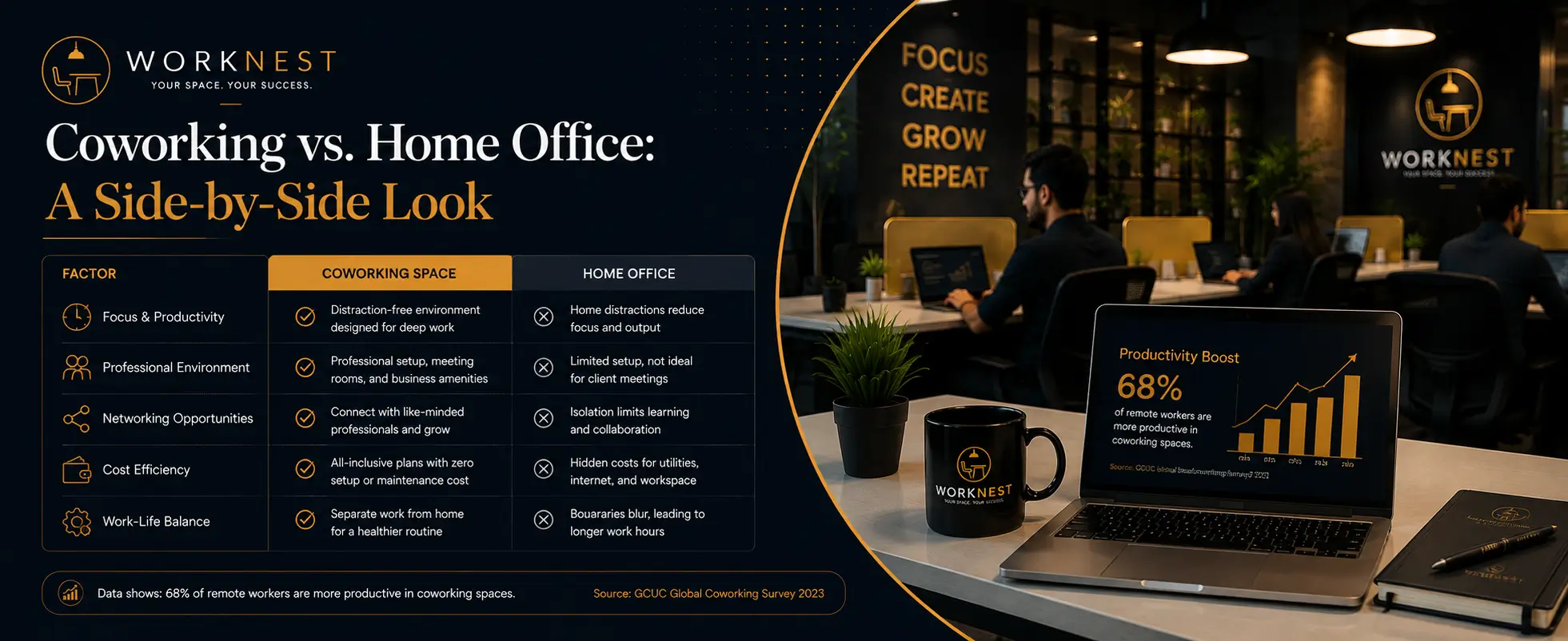
    Coworking vs. Home Office: A Side-by-Side Look

    Coworking vs. Home Office A Side-by-Side Look

    The choice usually comes down to four factors. Here’s how they compare directly for remote employees.

    Factor Home Office Coworking Space
    Cost Low fixed cost, but hidden costs in electricity, chai, snacks ₹699/day at WorkNest, predictable and expense-friendly
    Distractions Family, chores, deliveries, TV – hard to control Dedicated work zones, quiet cabins, and meeting rooms
    Internet reliability Dependent on residential broadband and local power supply Business-grade Wi-Fi and backup power as standard
    Social contact Minimal – isolation risk documented at 88% among remote-only workers Passive daily contact with other professionals reduces isolation

    This is the clearest way to answer the coworking vs home office remote workers debate: home wins on flexibility, coworking wins on consistency and consistency is what drives the productivity numbers above.

    How to Ask Your Employer to Cover It

    How to Ask Your Employer to Cover It

    Most companies already save on real estate by letting employees work remotely. Redirecting a fraction of that saving into a coworking stipend is a low-risk ask if you frame it right.

    Step 1: Lead with the business case, not the personal one. Cite the productivity data above. A 13% performance gain or a documented rise in focused output matters more to a manager than “I’d be happier.”

    Step 2: Bring exact numbers, not estimates. Vague requests get vague answers. WorkNest’s current published rates:

    Plan Price Best for
    Hot Desk ₹699/day Occasional remote work days
    Dedicated Desk ₹9,999/month Full-time remote employees
    Private Cabin ₹24,999/month Client calls, confidential work
    Meeting Room ₹799/hour Team syncs, client meetings

    Step 3: Propose a trial, not a permanent commitment. Ask for one month at the Dedicated Desk rate, framed as a productivity pilot with a before/after check-in.

    Step 4: Offer proof of ROI in India-specific terms. Note that flexible workspace stipends are a standard, budget-friendly line item , cheaper than most companies’ per-employee real estate cost, and far cheaper than turnover caused by burnout or isolation.

    Priya Singh, a Freelance Designer who works with multiple remote-first companies, negotiated her coworking cost into her project retainer by presenting it as a productivity investment rather than a perk  the same approach works for salaried employees.

    WorkNest has helped over 500 businesses in Jaipur make this exact case to employers and clients, backed by a 4.8 Google rating and a 91% renewal rate that shows members stay because the arrangement works.

    If you’re ready to see it for yourself, book a free office tour at WorkNest, E-3, 6D Engineers Colony, Mansarovar, Jaipur- our team responds to enquiries in under 30 minutes.

    FAQs

    Q1: Is a coworking space actually better than working from home for remote employees?

    Data suggests yes for most people: 74–85% of coworking members report higher productivity and motivation compared to working from home, largely due to fewer distractions and better infrastructure.

    Q2: Can I ask my employer to pay for a coworking membership?

    Yes. Frame it as a productivity investment backed by data, request a one-month trial, and provide exact pricing  most companies already save on office real estate by allowing remote work, so a modest stipend is an easy approval.

    Q3: What is a coworking stipend?

    A coworking stipend is a recurring allowance an employer pays a remote employee to cover a coworking desk or membership, similar to a home-internet or phone allowance.

    Q4: How much does a coworking space cost in Jaipur?

    At WorkNest in Mansarovar, Jaipur, a Hot Desk costs ₹699/day, a Dedicated Desk is ₹9,999/month, a Private Cabin is ₹24,999/month, and a Meeting Room is ₹799/hour.

    Q5: Does coworking really reduce loneliness for remote workers?

    Industry data shows 88% of coworking members report reduced isolation compared to working alone at home, since coworking spaces provide passive social contact even without formal networking.

    Q6: Is coworking worth it for a single remote employee, not a whole team?

    Yes , individual hot desk and dedicated desk plans are designed exactly for solo remote employees who need infrastructure and separation from home, without paying for a private office.

    Q7: How is coworking different from a traditional office for remote employees?

    Remote employees choose their coworking hours and location freedom while still getting office-grade Wi-Fi, meeting rooms, and printing  without a long-term lease or daily commute obligation tied to one employer.

    Q8: Are there tax benefits for coworking expenses in India?

    Estimated – verify before publishing. Salaried remote employees generally cannot claim a coworking desk as a personal tax deduction, but if an employer pays or reimburses it as a documented business expense, it may be treated as a deductible business cost for the company  check current Income Tax rules or consult a chartered accountant before relying on this for a specific filing.

  • How to Be Productive Working From a Coworking Space

    How to Be Productive Working From a Coworking Space

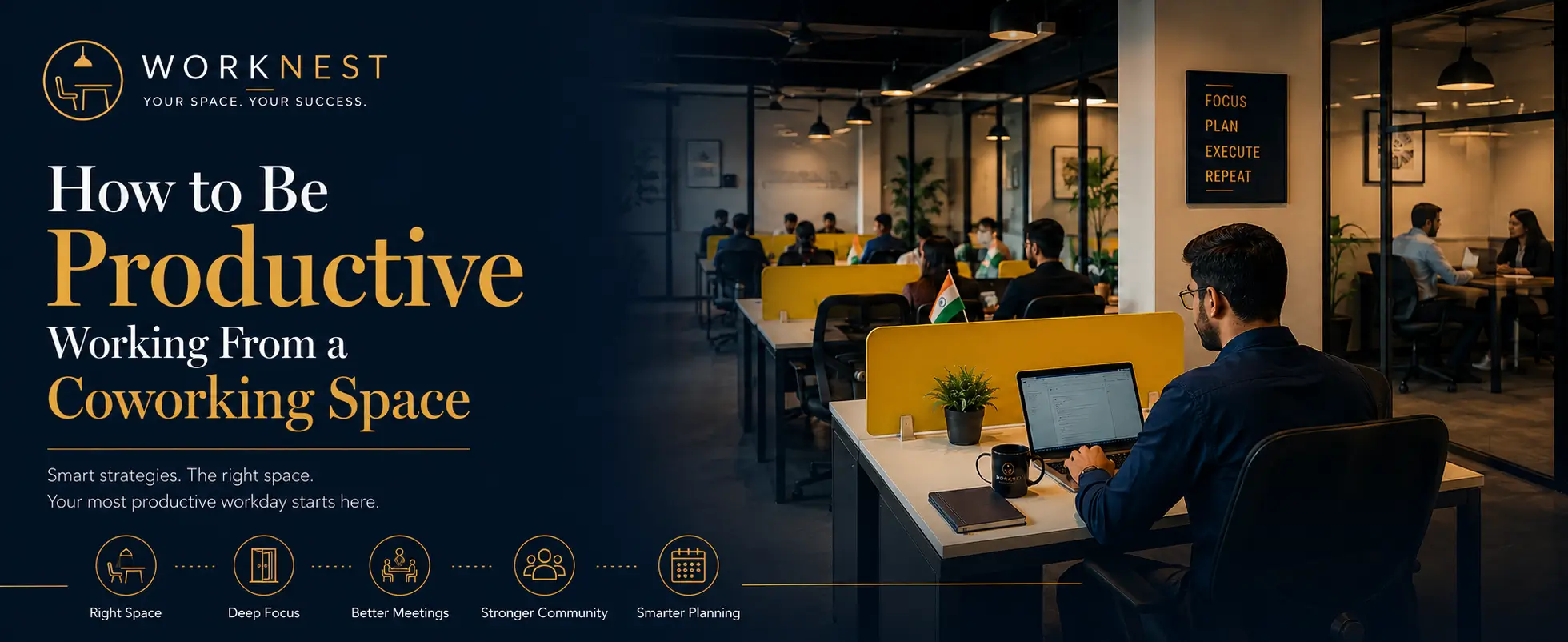
    The fastest way to stay productive in a coworking space is to match your desk type to your task, build a repeatable routine, and use zoned areas, like private cabins for deep work and meeting rooms for calls, instead of working from one seat all day. As of 2026, this “task-to-space” approach is what separates coworking members who thrive from those who drift.

    Coworking spaces solve the isolation of working from home, but they introduce a new problem: too much choice and too much stimulation. A packed hot-desk floor, constant footsteps, and the pull of the community lounge can wreck your focus just as easily as a noisy kitchen at home. The good news is that productivity in a shared office isn’t about willpower. It’s about structure.

    Most productivity guides for coworking spaces hand you a generic tip list and stop there. They rarely tell you which bookable space to actually use for which task. This guide does. Every tip below is tied to a real, bookable amenity you can act on today.

    At WorkNest in Mansarovar, Jaipur, we’ve helped 500+ businesses find what works for them, each at their own pace. Below are the tips that actually move the needle, tied to real, bookable amenities you can use starting today.

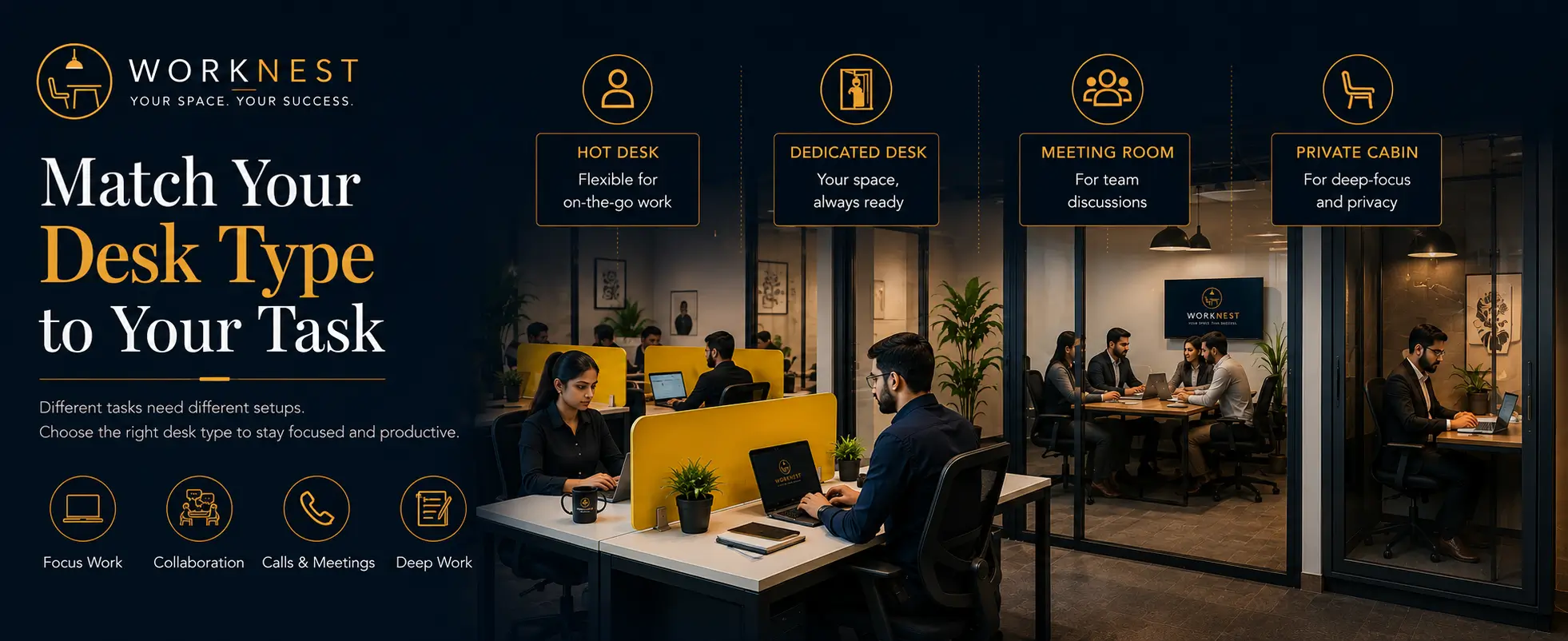
    1. Match Your Desk Type to Your Task

    match your desk type to your task

    Most coworking advice stops at “get a desk.” But not every task needs the same desk. Treat your desk type as a productivity tool, not just a seat.

    Desk Type Best For Price
    Hot Desk Occasional visits, light admin work, flexible days ₹699/day
    Dedicated Desk Daily routine, consistent workflow, personal setup ₹9,999/month
    Private Cabin Deep-focus work, client calls, confidential tasks ₹24,999/month
    Meeting Room Interviews, pitches, team syncs ₹799/hour

    If you’re at WorkNest three or more days a week, a Dedicated Desk removes the daily decision of “where do I sit,” which is a small but real drain on focus. Founder Aditi Rao puts it simply: “Having the same desk every day cut my setup time to zero. I just sit down and start.”

    2. Build a Routine You Repeat, Not Reinvent

    Productivity hacks fail when they’re one-off tricks. A coworking space routine works because it removes decisions. Try this structure:

    1. Arrive at the same time each day to anchor your body clock.
    2. Do your hardest task first, before the floor fills up and noise rises.
    3. Batch shallow work, email, scheduling, admin, for the afternoon lull.
    4. Leave at a consistent time so your brain learns the workday has an edge.

    Consultant Rohan Mehta books the same hot desk near the window every morning: “It’s not about the seat. It’s about starting the day the same way, every time.”

    Here’s what that looks like in practice. Rohan usually gets to WorkNest around 9:30 AM on most weekdays. He spends the first 90 minutes on client strategy work, before the floor gets busy. Between 11 AM and 1 PM, he handles calls and admin. After lunch, he batches any remaining meetings, then wraps up by 6 PM. The schedule rarely changes, and that’s the point. A fixed routine removes the daily question of “what should I work on next?” and leaves more mental energy for the work that really matters.

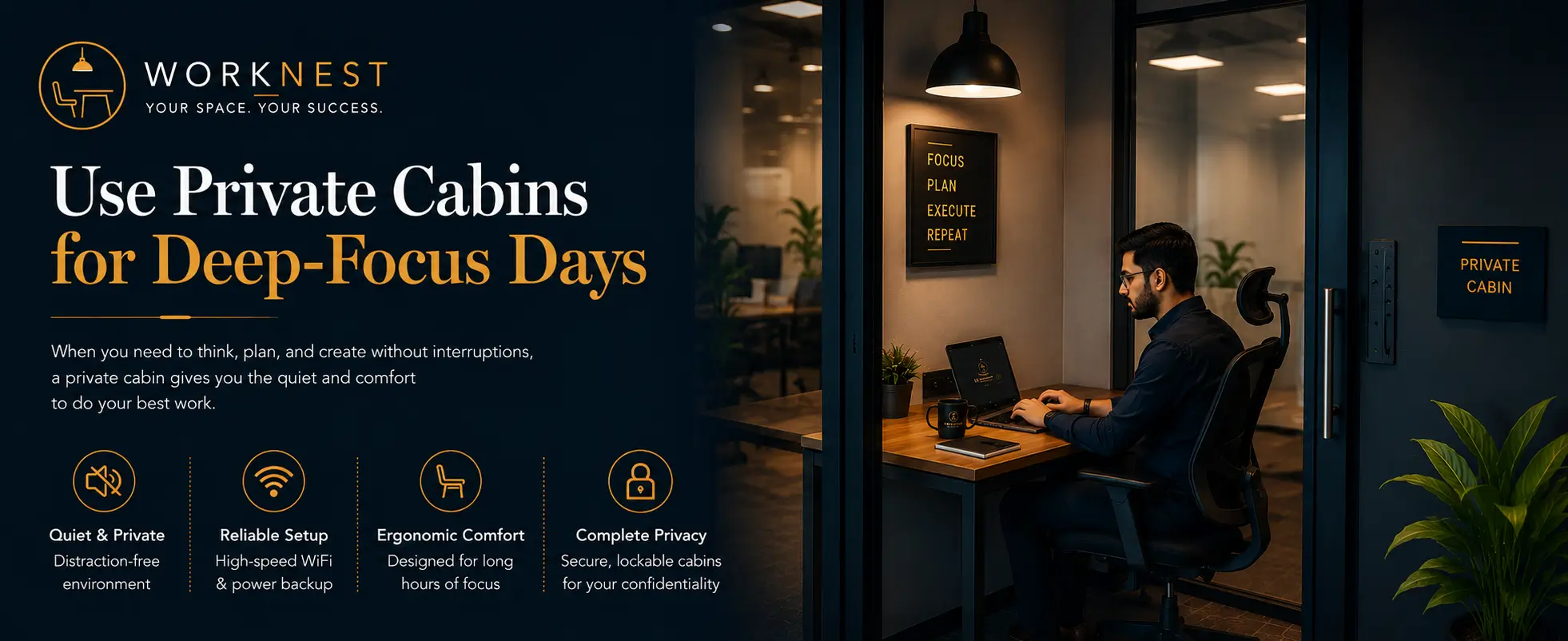
    3. Use Private Cabins for Deep-Focus Days

    use private cabins for deep-focus Days

    This is the tip most competitor articles skip entirely: your environment should change based on the type of work, not stay fixed. When a task needs two or three hours of uninterrupted focus, like a proposal, financial model, or design sprint, book a Private Cabin instead of trying to concentrate on the open floor.

    Freelance designer Priya Singh switches to a cabin for client deliverables: “On the open floor, I get pulled into conversations. In the cabin, I finish in half the time.”

    At ₹24,999/month, a Private Cabin isn’t a daily requirement for most members. It’s a tool you use when the day really matters.

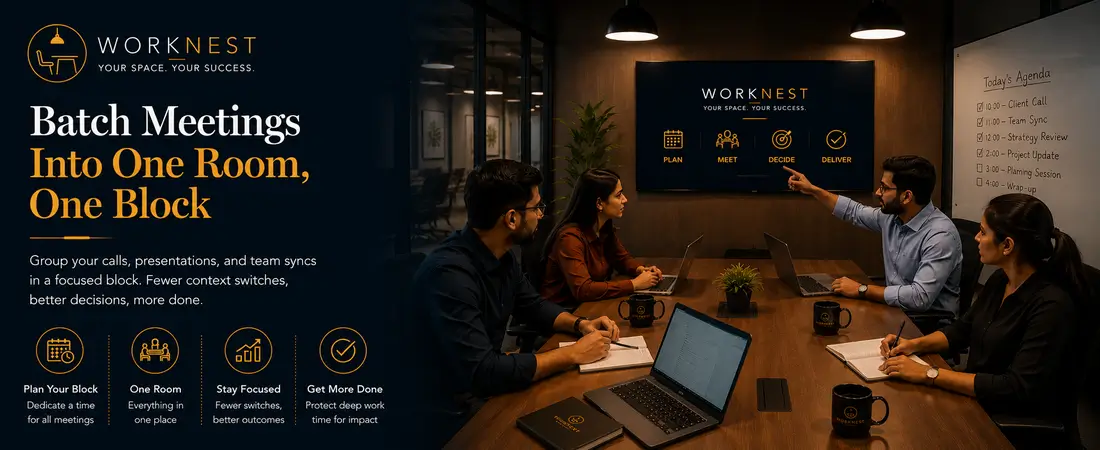
    4. Batch Meetings Into One Room, One Block

    batch meetings into one room one block

    Constantly leaving your desk for calls disrupts your focus and everyone else’s. Instead, batch your calls and meetings into a single block and book WorkNest’s Meeting Room for ₹799/hour.

    Sales lead Karan Malhotra batches client calls between 2 PM and 4 PM: “Everything outside that window waits. It has almost completely eliminated interruptions during my deep work.

    This also protects your desk time. The rest of your day stays free for focused, uninterrupted output.

    5. Set Zone Rules for Yourself

    Coworking floors aren’t neutral. Some zones invite conversation, others invite focus. Learn which is which at your space and use them on purpose.

    Zone Best Used For
    Lounge / café area Quick chats, casual calls, breaks
    Open desk floor Routine work, moderate-focus tasks
    Private cabin Deep work, confidential work, high-stakes deadlines
    Meeting room Scheduled calls and meetings only

    Treating zones as tools, not just furniture, is the single biggest gap in most generic coworking advice.

    6. Take Breaks on Purpose, Not by Accident

    Unstructured breaks (a scroll here, a chat there) add up fast in a social environment. Structured breaks protect your time instead. Try a short walk, a coffee break away from your desk, or five minutes of stretching every 90 minutes.

    Unplanned breaks cost more than they seem. A study from the University of California, Irvine, found that getting back into a task after an interruption can take around 23 minutes. So, a five-minute scroll can easily cost much more than five minutes of focus.

    The goal isn’t to avoid breaks. It’s to take breaks you choose, rather than breaks that happen to you.

    7. Use the Community as an Asset, Not a Distraction

    use the community as an asset, not a distraction

    One advantage a coworking space has over a home office is the people around you. Agency partner Meera Jain treats WorkNest’s community events as scheduled networking, not spontaneous interruptions: “I attend the events I plan for and skip the floor chatter I didn’t.”

    The fix is simple: engage with the community on your terms, at events, during breaks, over lunch, not every time someone walks past your desk.

    8. Review Your Week and Adjust Your Setup

    At the end of each week, ask which days you were sharpest and where you sat. Founder Arjun Nair reviews this monthly: “I noticed I get more done in the cabin on Mondays and Tuesdays, so now I book it in advance for those two days.” Small adjustments like this compound over a quarter.

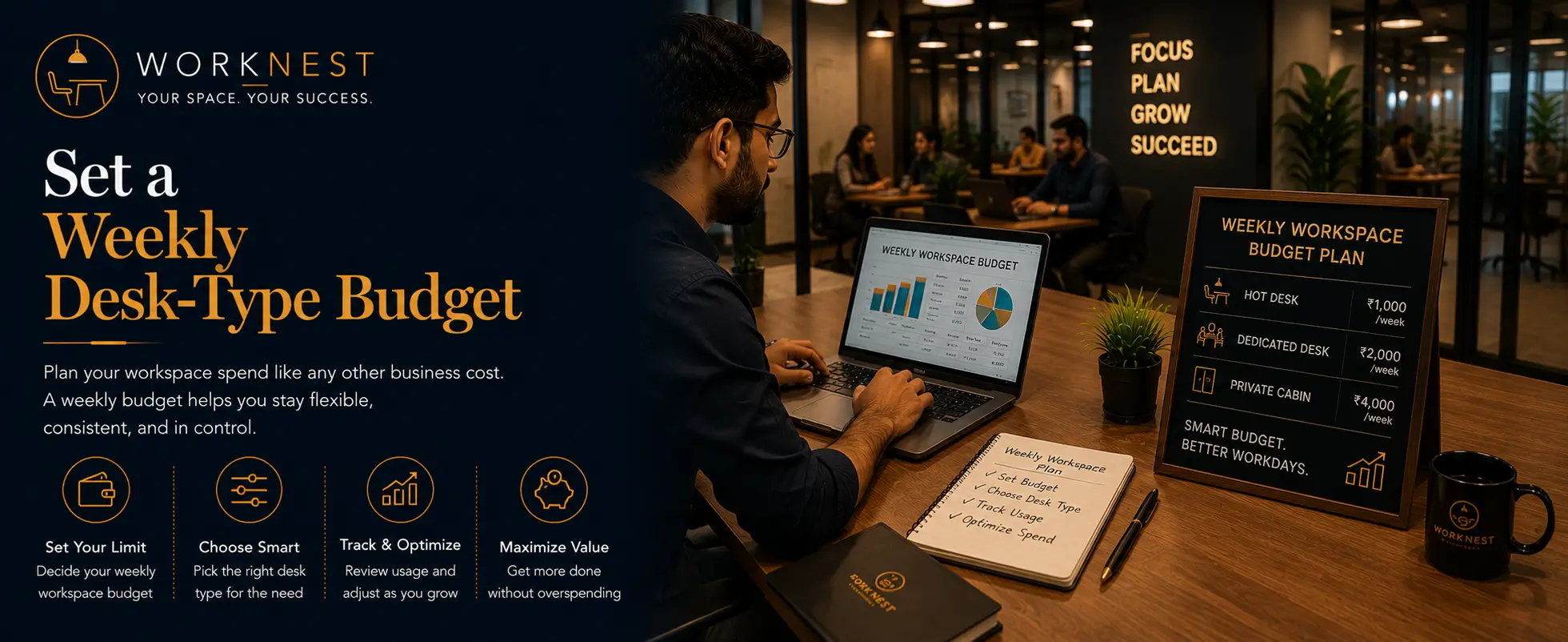
    9. Set a Weekly Desk-Type Budget

    set a weekly desk-type budget

    Most members default to one desk type and stick with it, even when the work changes week to week. Instead, plan your desk type the way you’d plan a budget. Look at your calendar every Monday and ask: how many deep-focus days do I have this week, how many meeting-heavy days, and how many routine days?

    Founder Arjun Nair does this at the start of every week: he books the Private Cabin for one or two focus-heavy days, keeps his Dedicated Desk for the rest, and reserves the Meeting Room only on days with client calls. This turns your workspace choice into a weekly decision instead of a fixed habit. It means you’re never paying for more cabin time than you actually need, or fighting for desk space on a day that needed a cabin.

    The Bottom Line

    Productivity in a coworking space isn’t about finding the perfect desk once. It’s about matching the right desk, room, and routine to the work in front of you, week after week. WorkNest members who do this consistently are part of why our renewal rate sits at 91%. People stay because the system works, not just the space.

    This is also why generic tip lists fall short. Knowing you should “avoid distractions” doesn’t help if you don’t have a private cabin to escape to, or a meeting room to batch your calls into. The tips above work because they’re built around real, bookable spaces, not abstract advice you can’t act on.

    WorkNest has applied this approach with 500+ businesses across Mansarovar, Jaipur, and holds a 4.8 Google rating, with a 30-minute response time for new inquiries. Whether you’re a founder, freelancer, consultant, or sales lead, the setup that works for you already exists here. You just need to book the right one for the day ahead.

    If you want to test this approach yourself, book a free office tour and try a Hot Desk, Dedicated Desk, or Private Cabin at WorkNest, E-3, 6D Engineers Colony, Mansarovar, Jaipur 302020, and find out which setup makes you most productive.

    Book a Free Office Tour →

    FAQs

    Q: What is the best desk type for productivity in a coworking space?

    A: It depends on the task. Use a Hot Desk (₹699/day) for occasional visits and light work, a Dedicated Desk (₹9,999/month) for daily routine work, and a Private Cabin (₹24,999/month) for deep-focus or confidential tasks.

    Q: How do I avoid distractions in a coworking space?

    A: Use zoned seating on purpose: open desks for routine work, private cabins for deep focus, and meeting rooms for calls, instead of doing every type of task from the same seat.

    Q: Is a private cabin worth it for focus work?

    A: Yes, for high-stakes or deadline-driven tasks. Members typically use a cabin selectively, not daily, reserving it for work that needs two or more uninterrupted hours.
    Q: How much does a coworking space cost in Jaipur?

    A: At WorkNest, pricing starts at ₹699/day for a Hot Desk, ₹9,999/month for a Dedicated Desk, ₹24,999/month for a Private Cabin, and ₹799/hour for a Meeting Room.

    Q: What’s a good daily routine for staying productive at a coworking space?

    A: Arrive at a consistent time, do your hardest task first, batch meetings into one block, batch shallow admin work for the afternoon, and leave at a consistent time.

    Q: Do coworking spaces help freelancers stay accountable?

    A: Yes. A fixed arrival time, a consistent desk, and a professional environment create structure that’s harder to maintain working from home alone.

    Q: How do I stop letting the coworking community distract me?

    A: Engage with community events and conversations at set times, like lunch or scheduled events, rather than every time someone passes your desk.

    Q: Should I switch desk types depending on my workload?

    A: Yes. Instead of sticking to one desk type all the time, review your calendar weekly and match your setup to that week’s mix of deep-focus days, meeting-heavy days, and routine days.

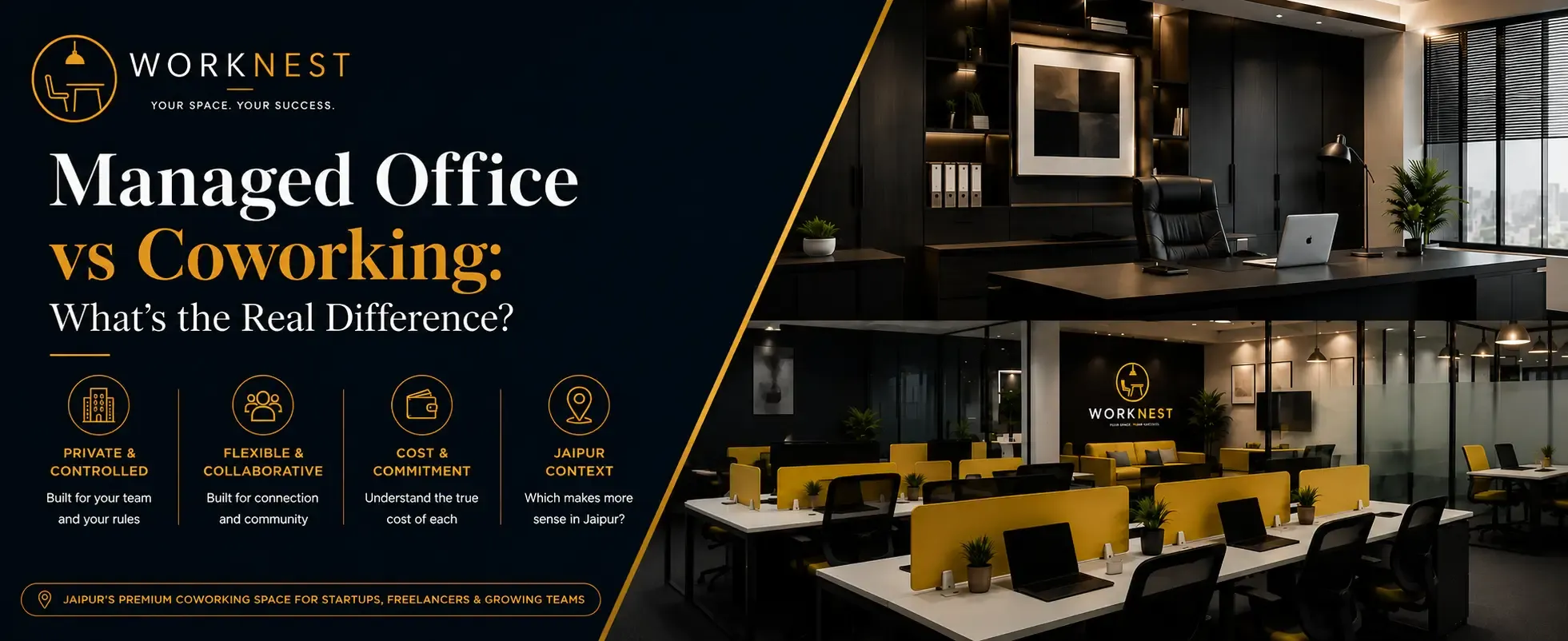
  • Managed Office vs Coworking: What’s the Real Difference?

    Managed Office vs Coworking: What’s the Real Difference?

    A managed office is a fully customized, privately branded workspace built and run for one company, while a coworking space is a shared, ready-to-use workspace rented by many companies at once. The real difference isn’t “premium vs budget”: it’s control and customization vs speed and flexibility. In 2026, growing SMEs in Jaipur often choose between the two because each fits a different stage of growth.

    This guide breaks down both formats honestly, including where managed offices genuinely win, so you can match the format to your team’s size, budget, and timeline, not just industry hype.

    What Is a Managed Office?

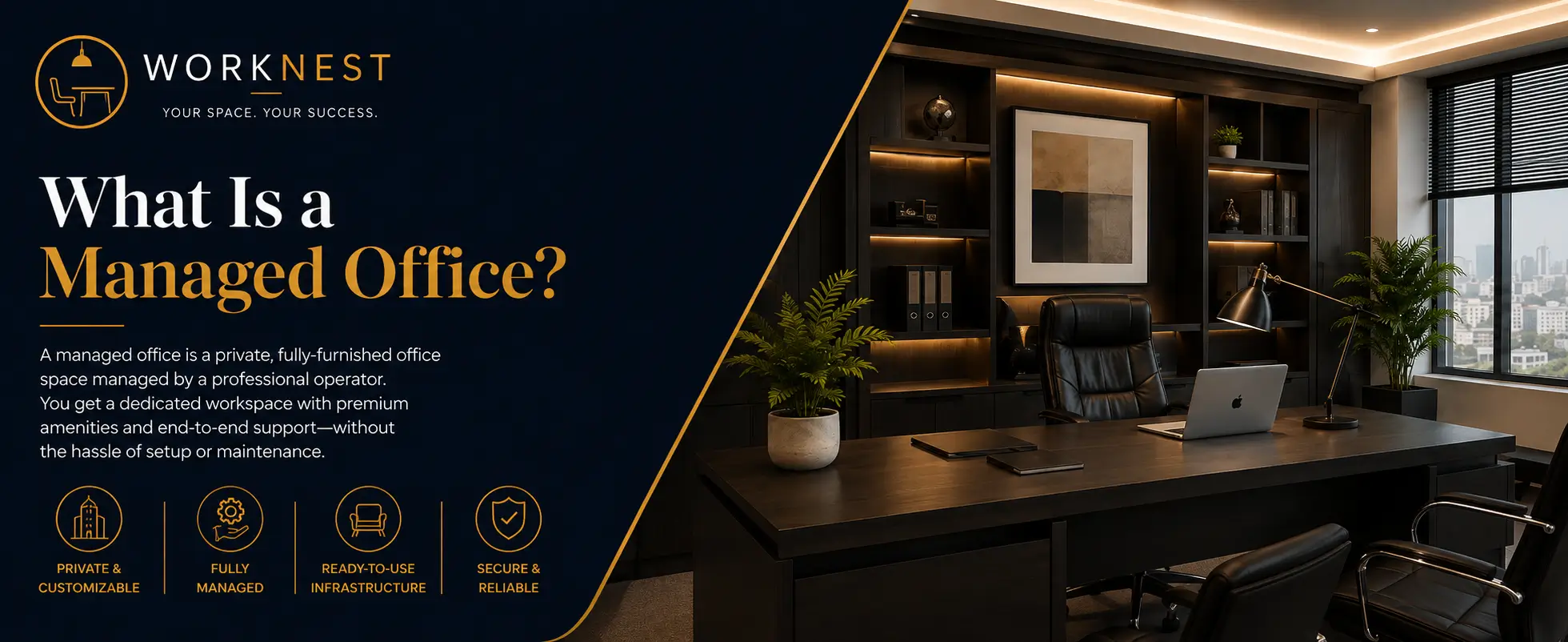
    A managed office is a workspace that an operator designs, builds, and manages exclusively for your company, inside a building the operator leases or owns. You get a dedicated floor or suite, your own branding, and full control over layout, while the operator handles construction, furniture, IT infrastructure, housekeeping, and facility management.

    Think of it as build-to-suit, minus the hassle. You’re not sharing a reception desk or a meeting room with strangers. Everything from the pantry to the server room is yours, configured to your specifications, and typically locked into a longer lease term than a coworking desk.

    Managed offices work best when:

    • Your team is large enough to fill a dedicated floor efficiently
    • You need full control over branding, security, and internal layout
    • You want a private, permanent address for client-facing credibility
    • You’re planning to stay in the same location for 3 to 5 years

    The trade-off is time and commitment. A standard commercial office fit-out typically takes 4 to 8 weeks for design and construction, based on WorkNest’s own published comparison of traditional office setup timelines; larger, fully custom managed-office floors can run longer than that baseline. Most operators also require multi-year lease commitments, typically 3 to 5 years. That’s a real cost for a team that’s still scaling and doesn’t yet know its exact headcount trajectory.

    What Is Coworking?

    what is coworking

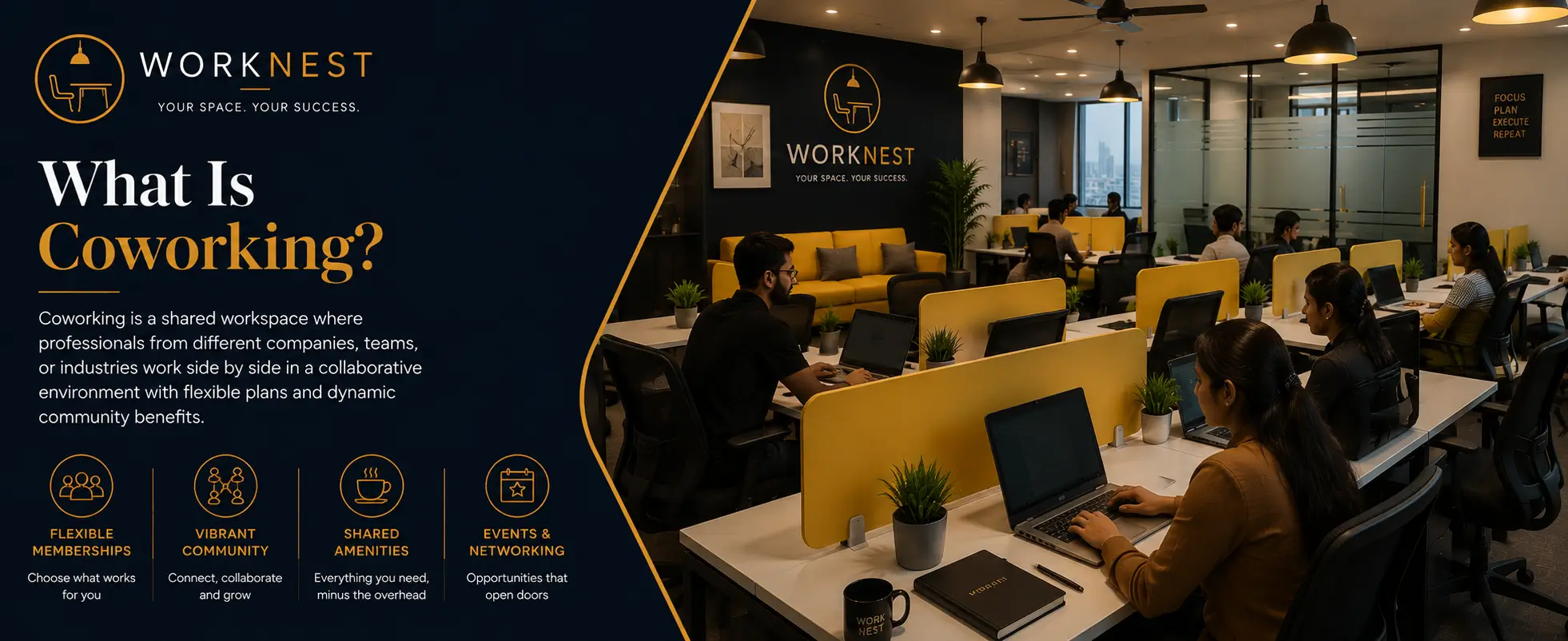
    Coworking is a shared, move-in-ready workspace where individuals and companies rent desks, cabins, or meeting rooms on flexible, often month-to-month terms. The space, furniture, internet, and common amenities already exist, so you show up and start working the same day.

    At WorkNest in Mansarovar, Jaipur, this looks like a Hot Desk at ₹699/day for a freelancer who needs a table for the afternoon, a Dedicated Desk at ₹9,999/month for someone who wants the same seat every day, or a Private Cabin at ₹24,999/month for a small team that wants a closed-door space without signing a five-year lease. Meeting rooms are bookable separately at ₹799/hour, so you’re not paying for conference space you use twice a week.

    Coworking works best when:

    • Your headcount fluctuates or is hard to predict 6 to 12 months out
    • You want to avoid setup time and upfront costs for furniture or IT.
    • You’re testing a new city or market before committing long-term
    • You need monthly, not multi-year, financial flexibility

    The trade-off is shared common areas and less control over branding: you’re one of many logos in the building, not the only one.

    Key Differences

    key differences

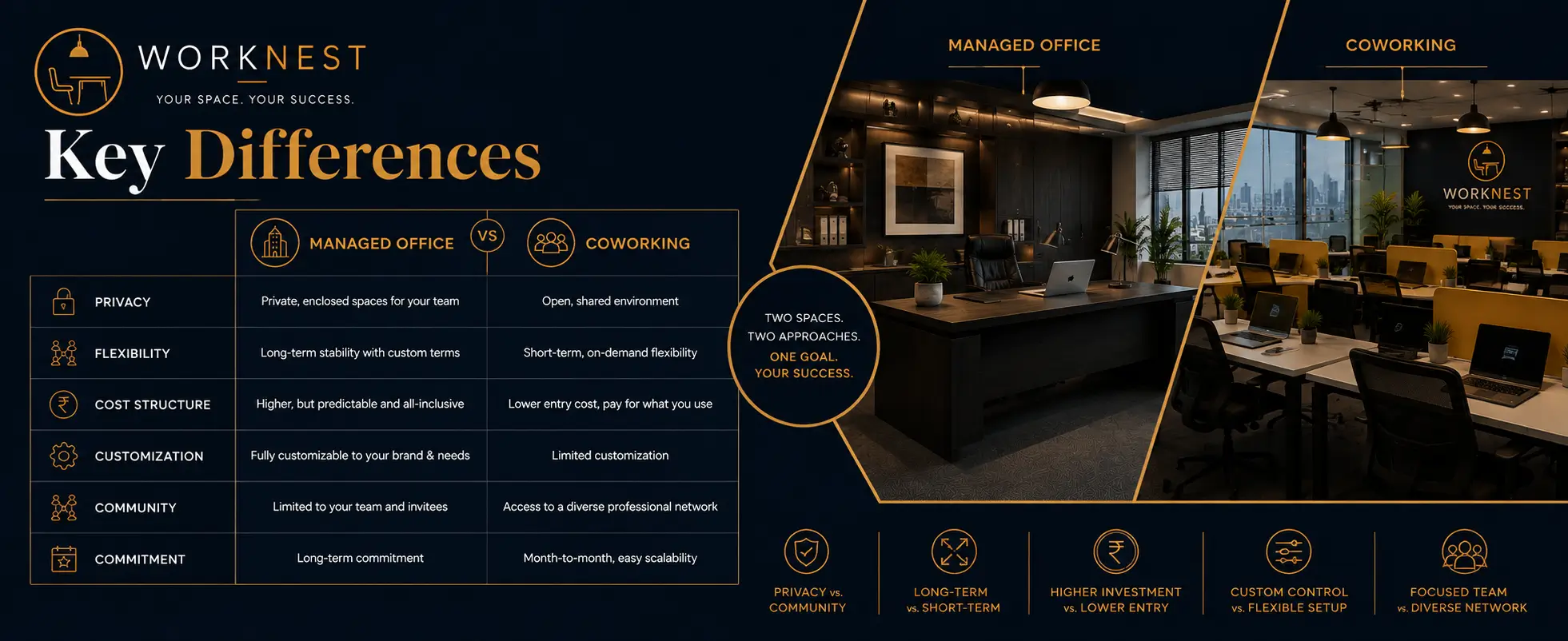
    The table below is the fastest way to compare both formats side by side.

    Factor Managed Office Coworking Space
    Setup time 4 to 8 weeks for a standard build; longer for large custom floors Same day
    Lease commitment Typically 3 to 5 years Monthly to yearly
    Branding and customization Your own private space with full branding Shared prices with limited branding
    Ideal team size 40+ seats, dedicated floor 1 to 40 seats, flexible desks or cabins
    Upfront cost High: fit-out, furniture, IT build Low to none
    Ongoing cost predictability Fixed per lease term Pay as you scale
    Amenities Custom-built to spec Shared: meeting rooms, pantry, internet
    Best for Established teams with stable headcount Growing, testing, or scaling teams

    Where Managed Offices Genuinely Win

    where managed offices genuinely win

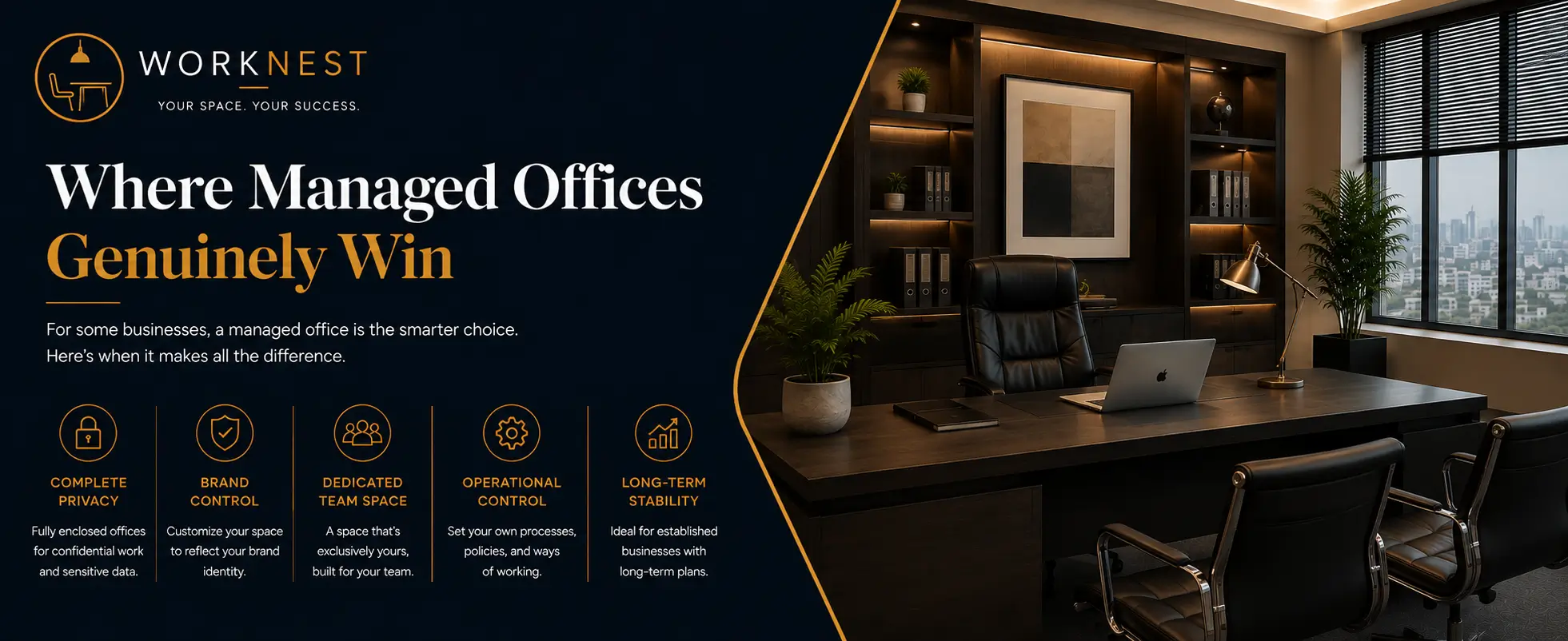
    It’s tempting to frame coworking as the modern, superior choice, but that’s not honest, and it’s not what the data supports for every business. Managed offices outperform coworking on three specific fronts.

    1. Cost per seat at scale. Once a team reaches around 40–50 people, a custom office can often be more cost-effective than coworking because fixed costs are spread across more employees. TableSpace’s own analysis, citing CBRE-FICCI flex-office data, points to the same pattern at enterprise scale; the same underlying trend is emerging for smaller 20 to 40 seat teams too.
    2. Brand control. A law firm, financial services company, or enterprise client-facing team often needs a private reception, controlled visitor access, and zero shared branding, something coworking structurally cannot offer.
    3. Long-term space planning. If you know your headcount and location for the next 3 to 5 years, a managed office locks in favorable long-term rates that a flexible coworking membership isn’t designed to offer.

    If your business fits any of these three, a managed office, not coworking, is the right call, even if it costs more upfront.

    Managed Office vs Coworking: The Jaipur Context

    managed office vs coworking the Jaipur context

    Jaipur’s flex-office market has grown fastest among SMEs and small consulting teams (1 to 25 people) rather than the 100+ seat enterprise floors that dominate metros like Gurugram or Bengaluru. That shifts the calculus locally: most Jaipur businesses evaluating “managed office space vs coworking space” are not deciding between two 50-seat options. They’re deciding whether they’ve outgrown a coworking desk yet.

    A dedicated managed workspace inside a coworking building, like a Private Cabin at WorkNest, is often the practical middle ground for Jaipur SMEs: private, lockable, and branded enough for client meetings, without the multi-year commitment a full managed office requires.

    Which Is Right for a Growing SME?

    Neither TableSpace’s enterprise lens nor a generic India-wide comparison answers the question most Jaipur founders actually have: “We’re 5 to 25 people, which one fits us right now?”

    Use this decision framework:

    Your situation Recommended format
    Team of 1 to 10, headcount uncertain Coworking: Hot Desk or Dedicated Desk
    Team of 10 to 25, need a private room but not a full floor Coworking Private Cabin
    Team of 25 to 40, stable and scaling predictably Hybrid: Private Cabin now, managed office in 12 to 18 months
    Team of 40+, fixed headcount for 3+ years Managed office
    Testing Jaipur before committing long-term Coworking, month-to-month

    For most SMEs in this range, the real answer isn’t “pick one forever,” it’s “start in coworking, and graduate to managed as headcount and budget stabilize.” That’s also the sequence many businesses working out of WorkNest have followed, growing from a single desk into full private cabins as teams expanded.

    Enterprise Flex Office: Where the Categories Blur

    A newer hybrid category, enterprise flex office, sits between the two. It offers managed-office-level customization and branding, but on flexible, coworking-style lease terms, often 1 to 3 years instead of 5+. It’s aimed at mid-size companies (50 to 150 people) that want control without a decade-long real estate commitment. This is a genuine third option, and if your team is approaching that size, it’s worth asking any operator, including WorkNest, whether a flex-managed hybrid is available before signing a traditional managed office lease.

    What This Looks Like in Practice

    “Moving to WorkNest cut our office setup time from two months to two days,” says Aditi Rao, Founder. That’s the practical speed advantage coworking has over a traditional build-out, and it’s the same advantage that makes coworking the right starting point for most growing teams.

    The same flexibility holds as teams expand. “We started with four desks and expanded to a cabin without changing address,” says Arjun Nair, Founder. That’s the practical advantage coworking has that a managed office, by design, doesn’t: you can grow into your space instead of pre-committing to it.

    The Bottom Line

    If you know your headcount for the next several years and need full branding control, a managed office is worth the setup time and lease commitment. If you’re still scaling, testing, or simply want predictable monthly costs without capex, coworking, including a private, lockable option like a WorkNest cabin, gets you working today without locking you in.

    WorkNest currently supports 500+ businesses across Jaipur, holds a 4.8 Google rating, and sees a 91% renewal rate: evidence that flexible, coworking-first setups keep working for growing teams long after the first lease term ends.

    Ready to see which format fits your team? Book a Free Office Tour at WorkNest’s Mansarovar campus and walk through Hot Desks, Dedicated Desks, and Private Cabins before you commit to anything.

    FAQs

    Q: What is the main difference between a managed office and a coworking space?

    A managed office is a private, fully customized workspace built exclusively for one company, usually on a multi-year lease. A coworking space is a shared, move-in-ready workspace rented flexibly, often month-to-month, by many companies at once.

    Q: Is a managed office more expensive than coworking?

    Upfront, yes: managed offices require fit-out and furniture costs coworking doesn’t. At scale (40+ seats), the per-seat cost can become competitive with coworking, but for teams under 40 people, coworking is typically the lower-cost option (industry estimate, not vendor-verified).

    Q: Can a coworking membership convert into a managed office later?

    Many operators, including flex-focused providers, let growing teams move from shared desks to private cabins and eventually into dedicated managed space as headcount stabilizes, rather than requiring a hard switch.

    Q: What is included in a managed office setup?

    Typically: dedicated floor or suite, custom furniture and branding, IT infrastructure, housekeeping, and facility management, all built to the tenant’s specification rather than shared with other companies.

    Q: How much does a managed office cost in Jaipur?

    Managed office pricing in Jaipur varies by location, fit-out level, and lease term, and is generally quoted per seat per month on a custom basis (market estimate, verify before publishing). For comparison, WorkNest’s coworking Private Cabins start at ₹24,999/month with no separate fit-out cost.

    Q: What is an enterprise flex office?

    It’s a hybrid format offering managed-office-level branding and customization on shorter, coworking-style lease terms (often 1 to 3 years), aimed at mid-size companies that want control without a long-term real estate commitment.

    Q: Is coworking suitable for a growing startup in Jaipur?

    Yes: coworking is designed for exactly this scenario, with uncertain headcount, limited capex, and the need to start working immediately. Teams can begin on a Dedicated Desk and move into a Private Cabin as they hire.

    Q: When should an SME upgrade from coworking to a managed office?

    Generally once headcount stabilizes above roughly 40 people and the company can commit to one location for 3+ years. Below that threshold, coworking’s flexibility usually outweighs a managed office’s control (industry estimate, not vendor-verified).

  • Hourly vs Daily Meeting Room Booking: Which Saves You More?

    Hourly vs Daily Meeting Room Booking: Which Saves You More?

    Book a meeting room hourly if your session runs under 4 hours; switch to a full-day booking once you cross 6 hours, since the running hourly total then costs more than a discounted day rate. At WorkNest in Mansarovar, Jaipur, the meeting room rate is a flat Rs 799 per hour as of 2026, and a full-day booking is estimated at Rs 5,499 (Estimated, verify before publishing) – well below the Rs 6,392 you’d pay across eight straight hourly bookings.

    That’s the short answer. Below is the exact math, followed by everything else you need to book the right way in Jaipur.

    Do the Math: Hourly vs Full-Day, Side by Side

    do the math hourly vs full day

    Here’s what different meeting lengths cost at WorkNest’s published hourly rate of Rs 799, compared with the estimated day-block quote:

    Meeting Length Cost at Rs 799/hour Best Booking Type
    1 hour Rs 799 Hourly
    2 hours Rs 1,598 Hourly
    3 hours Rs 2,397 Hourly
    4 hours (half-day) Rs 3,196 hourly vs Rs 2,999 half-day quote (Estimated) Compare both
    6 hours Rs 4,794 Compare with day quote
    8 hours (full day) Rs 6,392 hourly vs Rs 5,499 day quote (Estimated) Day quote wins

    The break-even point is simple: once a meeting or workshop runs past 5 to 6 hours, ask WorkNest for a day-block quote instead of paying the straight hourly rate. WorkNest’s estimated half-day (4-hour) rate is Rs 2,999, and the estimated full-day (8-hour) rate is Rs 5,499 (both labeled Estimated, verify before publishing, since WorkNest currently quotes day-blocks per booking rather than publishing one fixed figure). For anything under 4 hours, hourly booking is almost always cheaper and gives you more scheduling flexibility.

    Hourly Rates Explained

    hourly rates explained

    WorkNest’s meeting room pricing in Jaipur is straightforward: Rs 799 per hour, billed only for the time you book. There’s no minimum booking beyond one hour, and no separate member vs walk-in pricing tier – the rate is the same for everyone.

    This flat structure matters when you’re comparing meeting room pricing in Jaipur across coworking spaces, because many providers quote a starting-from range that hides service charges, projector fees, or minimum-hour requirements. WorkNest’s Rs 799/hour is the full, all-inclusive rate for the room itself.

    Booking a meeting room by the hour works best for:

    • Client calls and pitch meetings (1 to 2 hours)
    • Interview panels (2 to 3 hours)
    • Board or investor updates (1 to 3 hours)
    • Quick vendor negotiations (under 2 hours)

    If your team meets for a focused, time-boxed session, hourly booking keeps costs tied directly to actual usage, so you’re never paying for idle room time.

    As Karan Malhotra, Sales Lead, puts it: booking a meeting room hourly at WorkNest has made it easy to run client calls without renting a full office for a two-hour conversation – a good example of why hourly pricing suits short, focused meetings.

    When a Day Rate Makes Sense

    when a day rate makes sense

    A day rate, or a half-day meeting room rate, starts to make financial sense once your event crosses the 5 to 6 hour mark. Beyond that threshold, the running hourly total (Rs 4,794 at 6 hours, Rs 6,392 at 8 hours) usually exceeds WorkNest’s bundled day quote of roughly Rs 5,499 (Estimated, verify before publishing).

    Day-long or half-day bookings suit:

    • Full-day workshops or training sessions
    • Multi-round interview days
    • Offsite strategy sessions and planning retreats
    • All-day client onboarding or negotiation sessions

    As Meera Jain, Agency Partner, shared: running a full-day client workshop at WorkNest worked out cheaper than booking the room hour by hour, and the team never had to watch the clock between sessions.

    For day-long bookings, contact WorkNest directly for a confirmed quote before committing, since the day rate above is an estimate pending WorkNest’s written confirmation for your exact date and headcount.

    Conference room booking tip: If you’re unsure whether your session will run long, book hourly first and extend on the day – it’s easier to add hours to a room you already hold than to downgrade from a day-block you didn’t need.

    What’s Included

    what's included

    Every WorkNest meeting room booking, hourly or full-day, includes the same baseline, so you’re never comparing a stripped-down hourly rate against a fully-loaded day package. This is one place where general meeting-room guides stay vague; WorkNest’s inclusions are fixed regardless of booking length:

    • High-speed Wi-Fi
    • Display screen and presentation setup
    • Whiteboard
    • Climate-controlled seating for your booked headcount
    • On-site support with a 30-minute response time for any request

    There are no separate premium or standard room tiers at the Rs 799/hour price point – what you book is what you get, whether it’s one hour or eight.

    How to Book

    1. Choose your slot. Pick your date, start time, and duration – hourly or full-day.
    2. Confirm headcount and duration. For sessions under 4 hours, book hourly directly. For anything longer, request a day-block quote.
    3. Pay and lock the room. Confirmation typically comes within WorkNest’s standard 30-minute response window.

    WorkNest is located at E-3, 6D Engineers Colony, Mansarovar, Jaipur 302020, and has served 500+ businesses with a 4.8 Google rating and a 91% renewal rate – a strong signal that repeat bookers consistently choose WorkNest over one-off alternatives.

    The Bottom Line

    If you’re deciding whether to book a meeting room hourly vs daily, run the math first: multiply your expected hours by Rs 799. Under 4 hours, book hourly. Past 6 hours, request a day quote. Either way, WorkNest’s meeting room in Mansarovar, Jaipur gives you transparent, all-inclusive pricing with no surprise add-ons.

    Ready to lock in your slot? Book a Meeting Room at WorkNest today.

    FAQs

    Q1: Is it cheaper to book a meeting room hourly or for the full day?

    For sessions under 4 hours, hourly booking at Rs 799/hour is cheaper. Past 6 hours, WorkNest’s estimated day-block rate of Rs 5,499 typically costs less than the hourly total (Estimated, verify before publishing).

    Q2: What is WorkNest’s meeting room rate in Jaipur?

    WorkNest charges a flat Rs 799 per hour for its meeting room in Mansarovar, Jaipur, as of 2026, with no separate membership pricing.

    Q3: Is there a half-day meeting room rate at WorkNest?

    WorkNest’s estimated half-day (4-hour) rate is Rs 2,999, compared with Rs 3,196 across four separate hourly bookings (Estimated, verify before publishing).

    Q4: What’s included in the meeting room booking price?

    Every booking includes Wi-Fi, a display screen, a whiteboard, climate-controlled seating, and on-site support with a 30-minute response time, regardless of hourly or full-day duration.

    Q5: How far in advance should I book a meeting room in Jaipur?

    WorkNest recommends booking as soon as your meeting time is confirmed; typical confirmation comes within the 30-minute response window, but earlier booking secures your preferred slot.

    Q6: Do I need a WorkNest membership to book a meeting room?

    No. WorkNest’s meeting room is available to members and non-members at the same Rs 799/hour rate.

    Q7: What’s the best conference room booking tip if my meeting length is uncertain?

    Book hourly first, then extend on the day if needed – it’s simpler to add hours than to switch out of a day-block booking.

    Q8: Where is WorkNest located?

    E-3, 6D Engineers Colony, Mansarovar, Jaipur 302020.

  • Meeting Room Etiquette: How to Run a Professional Client Meeting

    Meeting Room Etiquette: How to Run a Professional Client Meeting

    Meeting room etiquette is the set of simple, professional habits, arriving early, testing your tech, and following up on time, that turn an ordinary booking into a client meeting people remember for the right reasons. Most guides to coworking meeting rooms stop at pricing and room types. This one focuses on what actually happens once you’re in the room, because that’s where deals are won or lost.

    Most meeting room guides cover pricing and room types, this one covers what to actually do once you’re inside, which is where competitors leave a gap.

    At WorkNest in Mansarovar, Jaipur, we’ve hosted client meetings for 500+ businesses as of 2026, and the pattern is consistent: the meetings that go well aren’t the ones in the fanciest room. They’re the ones where the host followed a simple before-during-after checklist. Here’s that checklist, step by step.

    Before the Meeting

    before the meeting

    Preparation is where most professional client meetings are actually decided. Use this coworking meeting room checklist 15-30 minutes before your guests arrive.

    1. Book the right room size, with a buffer. Choose a meeting room rated for at least two more people than your headcount. A 6-person room for a 6-person meeting feels cramped once laptops and coffee cups are on the table.
    2. Arrive 10-15 minutes early. This is the single highest-impact habit in professional video call etiquette and in-person meetings alike. It gives you time to fix problems before your client sees them.
    3. Test the tech before anyone walks in. Test your laptop, display, microphone, and speakers before the meeting begins. A dead HDMI cable at minute one undermines your credibility instantly.
    4. Confirm Wi-Fi and have a backup. Ask the front desk for the current network name and password, and note your phone’s hotspot as backup in case of drops.
    • Set the room, not just the table. Lay out printed agendas or name cards if it’s a multi-person meeting. Adjust the lighting and blinds to keep your video clear and well-lit.
    • Send a calendar confirmation with the exact address. Share the full address—E-3, 6D Engineers Colony, Mansarovar, Jaipur 302020—along with any parking or entry instructions at least one day before the visit.
    • Order refreshments in advance, not on arrival. Coffee, water, or snacks ordered ahead means no one is waiting on service mid-meeting.

    During the Meeting

    during the meeting

    Once your client is in the room, etiquette shifts from logistics to conduct. This is where a client meeting checklist earns its keep.

    • Start on time, even if someone is late. Waiting more than five minutes signals that your own schedule is negotiable. Begin with a short recap for latecomers instead.
    • Open with the agenda and the time box. State how long the meeting will run and what you plan to cover. This single habit is the most-cited fix for professional video call etiquette complaints.
    • Mute notifications and put phones face-down. A buzzing phone mid-pitch is one of the fastest ways to signal distraction to a client.
    • Assign a note-taker if there’s more than one person on your side. Someone dedicated to notes means the lead can stay fully present in the conversation.
    • Watch the clock, not just the conversation. Give a verbal check-in at the halfway mark: “We’re at the 15-minute mark of our 30, let’s make sure we cover X and Y.”
    • Handle overrun gracefully. If you’re running long, name it directly: “We’re past our booked time, should we wrap the key decision now, or book 15 more minutes?” This shows respect for both your client’s time and the next booking.
    • Close with clear next steps. End every meeting by stating, out loud, who owns what and by when, before anyone stands up to leave.

    After the Meeting

    after the meeting

    Follow-up etiquette is the most commonly skipped step, and it’s the one clients remember longest.

    • Send a follow-up email within 24 hours. Summarize decisions, action items, and owners. A follow-up email sent the same day is much more likely to be read than one sent days later.
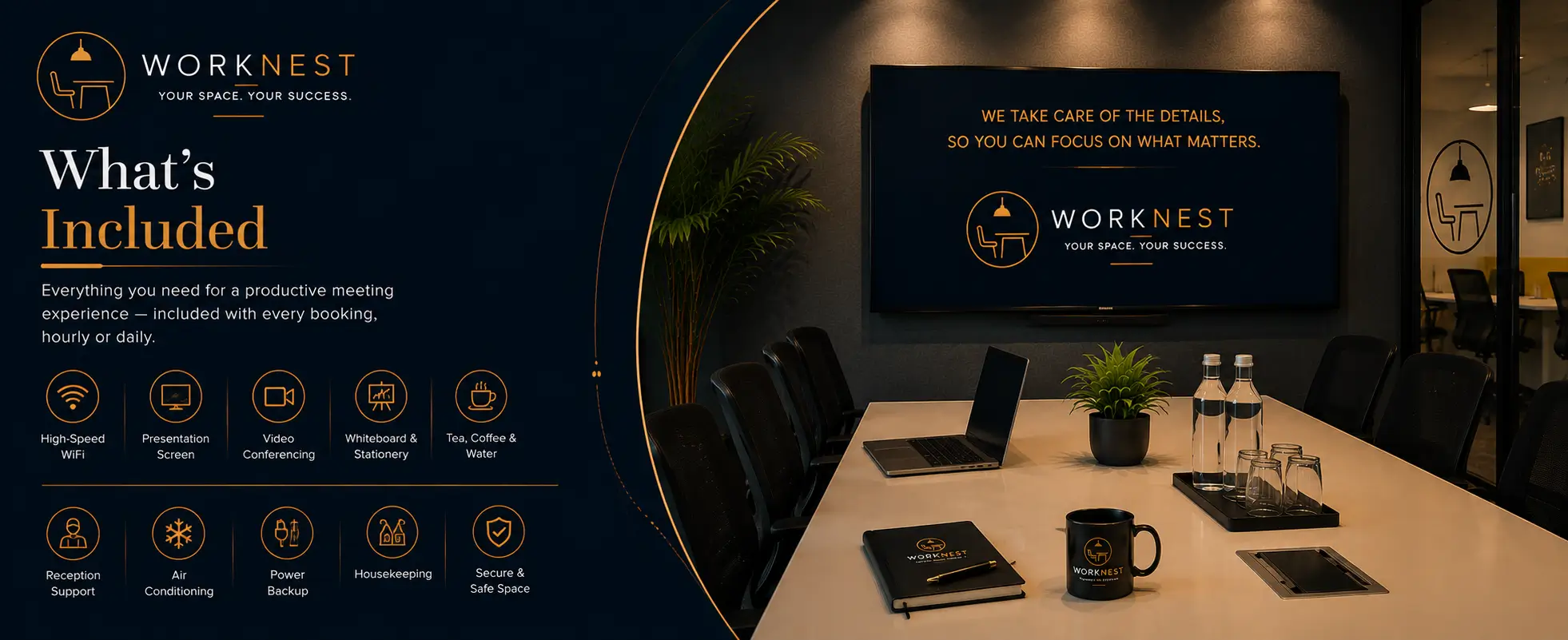
    • Return the room to a clean, reset state. Clear cups, wipe the table, and leave the display disconnected, the next booking may start within the hour.
    • Log any tech issues with the space team. If the projector lagged or Wi-Fi dropped, report it immediately so it’s fixed before your next booking.
    • Confirm the next touchpoint. Whether it’s another meeting or a proposal deadline, put a specific date on it before the thread goes cold.

    As Meera Jain, an agency partner who books WorkNest meeting rooms regularly for client pitches, puts it: consistent follow-up is what separates a good meeting from a good deal. Karan Malhotra, a sales lead who hosts client meetings at WorkNest, says sending a summary email the same day is one of the simplest ways to keep deals moving. Estimated, verify before publishing: teams that send same-day follow-ups tend to keep more meetings moving toward a decision than teams that delay.

    How to Choose the Right Meeting Room

    how to choose the right meeting room

    Not all coworking meeting rooms offer the same experience. Use this checklist to find the right one before you book.

    Feature Why it matters WorkNest Mansarovar
    Display + video conferencing setup Avoids the “test the tech” step turning into a scramble Included
    High-speed Wi-Fi with backup Prevents dropped client calls Included
    Soundproofing Confidential client conversations stay confidential Included
    Reception support Guests are greeted and directed without you stepping out Included, 30-min response time
    Flexible hourly booking Lets you time-box meetings precisely ₹799/hour

     WorkNest’s meeting rooms are priced at ₹799/hour. For teams that need a room on standby every week, Hot Desk access is ₹699/day, Dedicated Desk is ₹9,999/month, and Private Cabin is ₹24,999/month. With a 4.8 Google rating and a 91% renewal rate among member businesses as of 2026, the space is built around exactly this kind of repeat, professional use.

    Rohan Mehta, a consultant who runs weekly client meetings from WorkNest, says the reception team’s fast response time means he never has to leave a meeting to solve a room problem, which is, in itself, good meeting room etiquette on the venue’s side.

    Running a professional client meeting comes down to the same three phases every time: prepare before, stay disciplined during, follow up after. Master that sequence, in a room built to support it, and meeting room etiquette stops being a soft skill and becomes a competitive edge.

    Ready to run your next client meeting right? Book a Meeting Room at WorkNest Mansarovar, Jaipur.

    FAQs

    Q1: What is meeting room etiquette?

    Meeting room etiquette is the set of professional habits that govern how you prepare for, conduct, and follow up on a meeting, arriving early, testing tech in advance, staying on time, and sending a follow-up within 24 hours.
    Q2: How early should I arrive before a client meeting?

    Arrive 10-15 minutes early. This gives you time to test the display, confirm Wi-Fi, and set up the room before your client walks in.

    Q3: What’s the biggest meeting etiquette mistake people make?

    Skipping the follow-up. Meetings that end without a same-day summary email lose momentum, even when the in-room conversation went well. Estimated, verify before publishing: teams that follow up same-day tend to keep more deals moving than teams that wait.

    Q4: How do I handle a client meeting that’s running over time?

    Name the overrun directly and offer a choice: wrap the key decision now, or book additional time. This respects both your client’s schedule and the next booking in the room.

    Q5: What’s proper video call etiquette in a coworking meeting room?

    Mute notifications, join a test call before your guest connects, state the agenda and time box at the start, and keep phones face-down during the call.

    Q6: What should I check before booking a coworking meeting room?

    Confirm the room has a working display and video conferencing setup, high-speed Wi-Fi with a backup option, soundproofing, and reception support, WorkNest’s meeting rooms include all of these at ₹799/hour.

    Q7: How much does a meeting room cost at WorkNest Mansarovar, Jaipur?

    WorkNest’s meeting rooms are ₹799/hour, with additional options including Hot Desk at ₹699/day, Dedicated Desk at ₹9,999/month, and Private Cabin at ₹24,999/month.

  • How Much Does a Private Cabin Cost in Jaipur?

    How Much Does a Private Cabin Cost in Jaipur?

    A private cabin at WorkNest in Mansarovar, Jaipur, costs ₹24,999 per month, flat rate -not per seat. That’s the direct answer to the question most people search first. The number that matters more, though, is the second one: is it flat or per-seat? At WorkNest it’s flat. You pay one price for the whole cabin, no matter how many desks are inside it, as of August 2026.

    That distinction is where most cost confusion starts. Jaipur’s coworking marketplaces typically quote prices per seat, so the real monthly bill climbs with every hire. This guide breaks down WorkNest’s private cabin pricing, exactly what’s included, how it compares to the wider Jaipur market, and how flat-rate cabins stack up against per-seat billing – so you can budget accurately before you book a tour.

    WorkNest Private Cabin Pricing

    worknest private cabin pricing

    WorkNest offers one private cabin plan, priced simply, with no hidden per-head charges.

    Plan Price Billing Best For
    Private Cabin ₹24,999/month Flat rate (whole cabin) Founders, small teams, private office seekers
    Dedicated Desk ₹9,999/month Per desk Solo professionals wanting a fixed spot
    Hot Desk ₹699/day Per day Freelancers, occasional users
    Meeting Room ₹799/hour Per hour Client calls, interviews, team syncs (capacity 4–12 people)

    For context, myHQ’s own Jaipur coworking listing page states an average citywide coworking price of roughly ₹5,300 per seat per month, with individual centers quoted anywhere from about ₹4,500 to ₹12,500 per seat. That’s a per-seat figure for general desks, not a cabin-specific quote but it illustrates the math: at ₹5,300 per seat, a five-person team billed per seat would already cost more per month than WorkNest’s flat-rate cabin for the same headcount.

    This ₹24,999/month private cabin cost is current as of August 2026. Coworking pricing can shift with occupancy, so we recommend confirming the exact rate on a walkthrough before signing a five-minute step that avoids surprises later.

    Founder Aditi Rao, a WorkNest member, said the flat monthly rate let her plan her office budget without recalculating costs every time she hired someone new.

    What’s Included

    A private cabin for startups pricing at ₹24,999/month at WorkNest isn’t a bare room. It includes:

    • Lockable, private cabin space  your team’s own enclosed office, not a shared zone
    • Furnished desks and ergonomic chairs sized to your headcount
    • High-speed Wi-Fi and power backup, so outages don’t stop your workday
    • Access to common meeting rooms at the discounted member rate (₹799/hour)
    • Reception and mail handling, plus CCTV security and pantry access
    • Housekeeping and maintenance included in the flat fee
    • 30-minute response time for any facility request – WorkNest’s standard service commitment across all plans

    This is where lockable cabin coworking cost comparisons often break down elsewhere. Both myHQ and Qdesq list private cabins alongside dozens of other spaces without a dedicated pricing breakdown for what’s bundled in  you often have to click into each individual listing to see whether furniture, Wi-Fi, or reception are included or billed separately. WorkNest bundles all of this into the flat ₹24,999/month upfront, so the number you see is close to the number you pay.

    Consultant Rohan Mehta, a WorkNest member, has said the included meeting room access made client calls feel more professional than his old office setup.

    Per-Seat vs Flat Rate

    per-seat vs flat rate

    This is the single biggest source of confusion in private office price Jaipur searches, and it deserves a direct answer.

    Per-seat pricing charges you per person using the cabin. myHQ’s own Jaipur FAQ confirms this is the norm for teams of 5–20 people, describing private cabins as one option alongside per-seat fixed desks  without spelling out that a cabin billed per seat gets more expensive with every hire. Flat-rate pricing, WorkNest’s model, charges one price for the entire cabin no matter how many desks fit inside it.

    Pricing Model How It Works Cost as Team Grows
    Per-seat (myHQ Jaipur average: ~₹5,300/seat/month) Price × headcount Rises with each new hire
    WorkNest flat rate One price for whole cabin Stays at ₹24,999/month within cabin capacity

    Using myHQ’s own stated citywide average as a reference point: a team of five billed per seat at that rate would pay roughly ₹26,500/month, already above WorkNest’s flat ₹24,999/month cabin  and the gap widens with every additional hire.

    Agency partner Meera Jain, a WorkNest member, said transparent pricing and responsive support made her team’s move straightforward,  no renegotiation needed as headcount changed.

    The practical takeaway: team office cost in Jaipur is predictable with flat-rate cabins and unpredictable with per-seat billing. Founder Arjun Nair’s experience makes the point concretely -his team started with four desks in a shared setup and expanded into a private cabin without changing their business address or renegotiating a new lease.

    How Many People Fit in a Private Cabin?

    how many does a private cabin cost in Jaipur

    Neither myHQ nor Qdesq’s Jaipur pages state a single standard cabin size, since capacity varies property by property. Looking at myHQ’s own individual Jaipur-area cabin listings for reference, private cabins in the market typically come in 4-seat and 6-seat configurations, with some centers offering 8-seat units. WorkNest’s cabin capacity follows the same small-team range; exact seating for the unit available at booking time is best confirmed on a tour, especially if you’re sizing a cabin around a specific headcount like Arjun Nair’s four-person team.

    Private Cabin vs. a Traditional Officeprivate cabin vs. a traditional office

    Comparing a coworking private cabin to leasing a standalone office in Jaipur comes down to a few concrete differences, not just the monthly number.

    Factor Traditional Office WorkNest Private Cabin
    Setup time 4–8 weeks Same day
    Lease commitment 3–5 years Monthly, flexible
    Upfront cost High – interiors, furniture, deposit Low, all-inclusive plan
    IT and maintenance Self-managed Fully managed
    Meeting rooms Separate cost Included at member rate
    Scalability Difficult, requires renegotiation Instant, flexible

    Qdesq’s own Jaipur pages quote standalone serviced offices anywhere from roughly ₹5,500 to ₹30,000 per month before furniture, deposit, and IT setup are added  costs a flat-rate cabin at WorkNest avoids entirely, since furniture, IT, and maintenance are already bundled into the ₹24,999/month fee.

    Location and Getting Started

    WorkNest’s private cabins are at E-3, 6D Engineers Colony, Mansarovar, Jaipur 302020 , a 20-minute walk from MI Road, a 10-minute drive from Ajmer Road, and roughly 25 minutes from Malviya Nagar and Jaipur International Airport.

    Booking follows three steps: book a tour (confirmed within 30 minutes), walk the space and choose your plan, then move in  most members are in within 24 hours of signing. Reach the team directly at +91 92564 22964 or worknest.jaipur@gmail.com to confirm current private cabin availability.

    Why This Matters for Your Budget

    why this matters for your budget

    WorkNest serves 500+ businesses across Jaipur, holds a 4.8 Google rating, and sees a 91% renewal rate among members. Those numbers reflect how members experience transparent, flat-rate pricing over time. Freelance designer Priya Singh said having a real business address, backed by predictable overhead, changed how clients perceived her work.
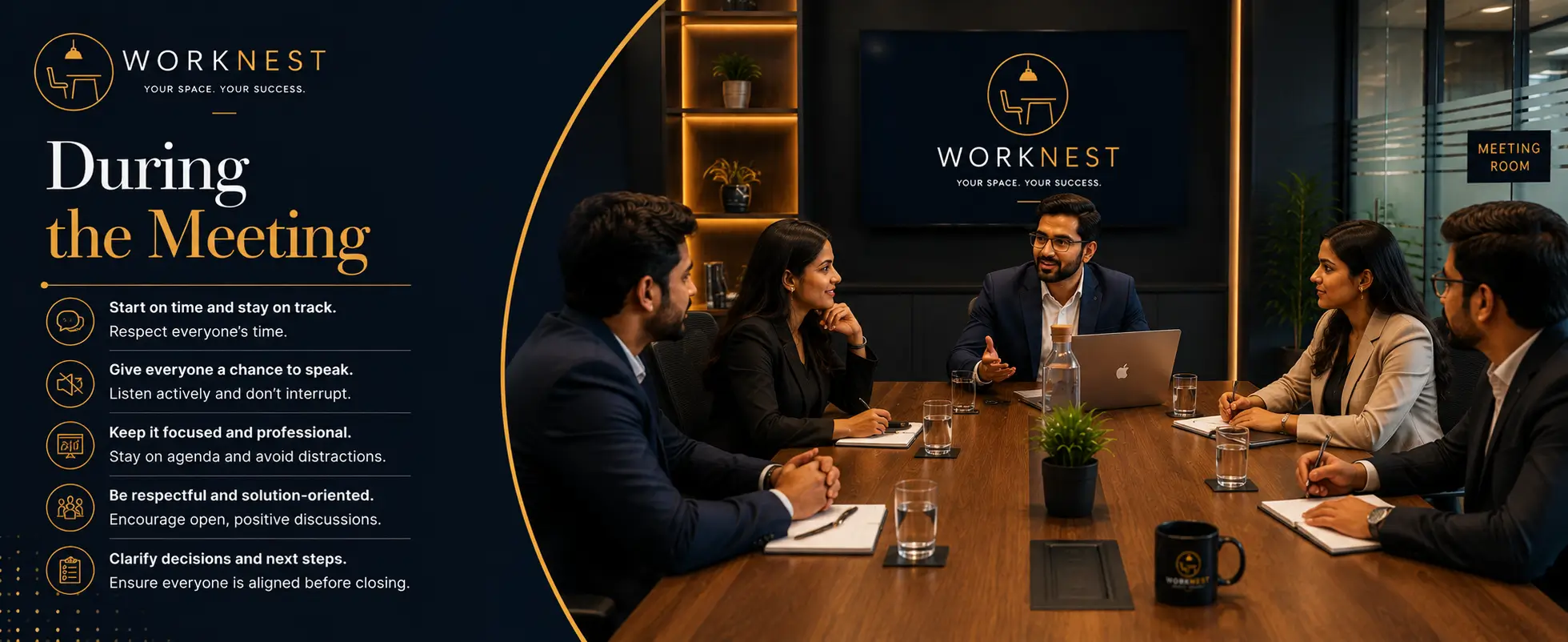
    If you’re comparing private cabin cost in Jaipur across multiple providers, ask each one directly: is this price per seat or per cabin? That single question reveals more about your real monthly cost than any “starting from” figure on a listings page.

    Next Step

    WorkNest’s private cabin costs ₹24,999/month, flat rate, at E-3, 6D Engineers Colony, Mansarovar, Jaipur 302020. Confirm exact current pricing and cabin availability on a free walkthrough – book a tour and get pricing today.

    Last updated: August 2026.

    FAQs

    Q1: How much does a private cabin cost in Jaipur at WorkNest?

    A WorkNest private cabin costs ₹24,999 per month, billed as a flat rate for the entire cabin, as of August 2026. Confirm exact current pricing on a tour, since rates can shift with occupancy.

    Q2: Is WorkNest’s private cabin priced per seat or flat rate?

    It’s a flat rate. You pay ₹24,999/month for the whole cabin, regardless of how many team members use it  unlike per-seat models common on Jaipur coworking marketplaces, where cost rises with each added person.

    Q3: What’s included in the private cabin price?

    The ₹24,999/month rate includes the lockable cabin, furnished desks and chairs, Wi-Fi with power backup, discounted meeting room access, reception, CCTV security, housekeeping, and a 30-minute facility response time.

    Q4: How many people can fit in a WorkNest private cabin?

    Jaipur’s coworking market typically offers private cabins in 4-, 6-, and 8-seat configurations. WorkNest’s cabins fall in that same small-team range; confirm exact seating capacity for your team size during a tour.
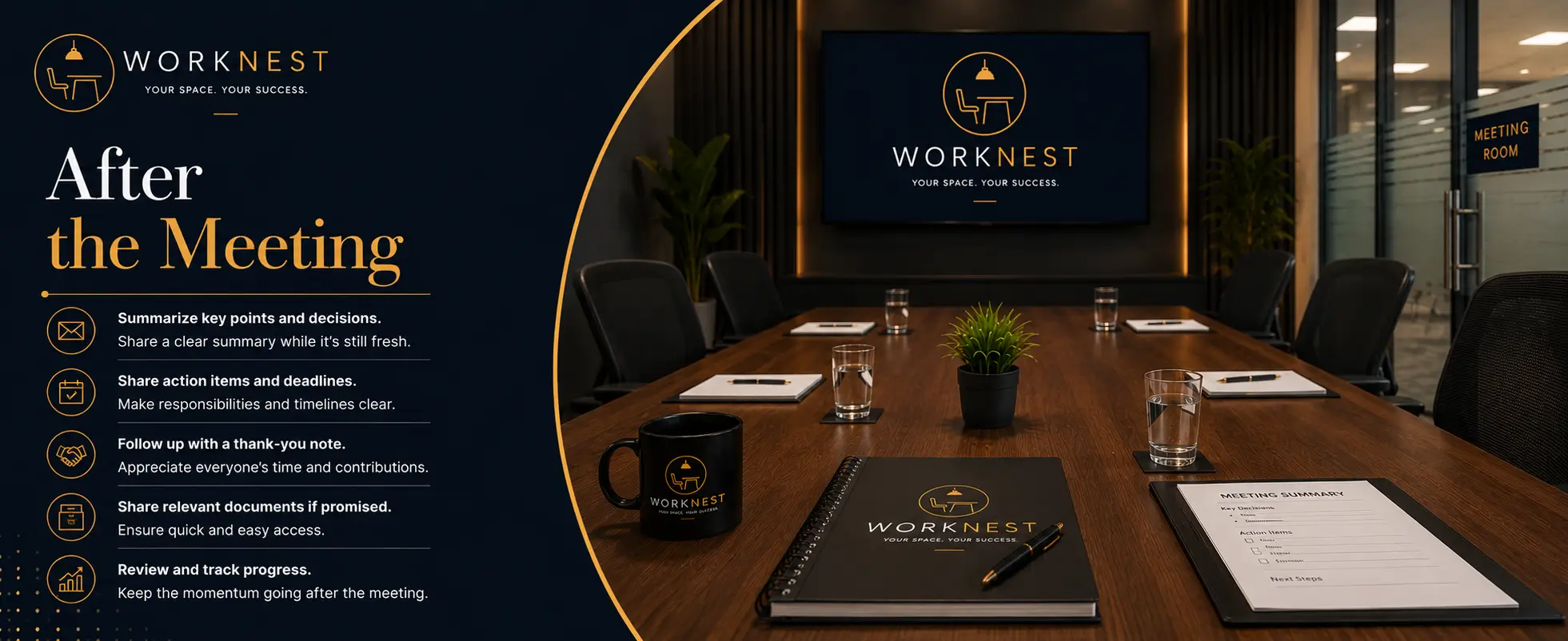
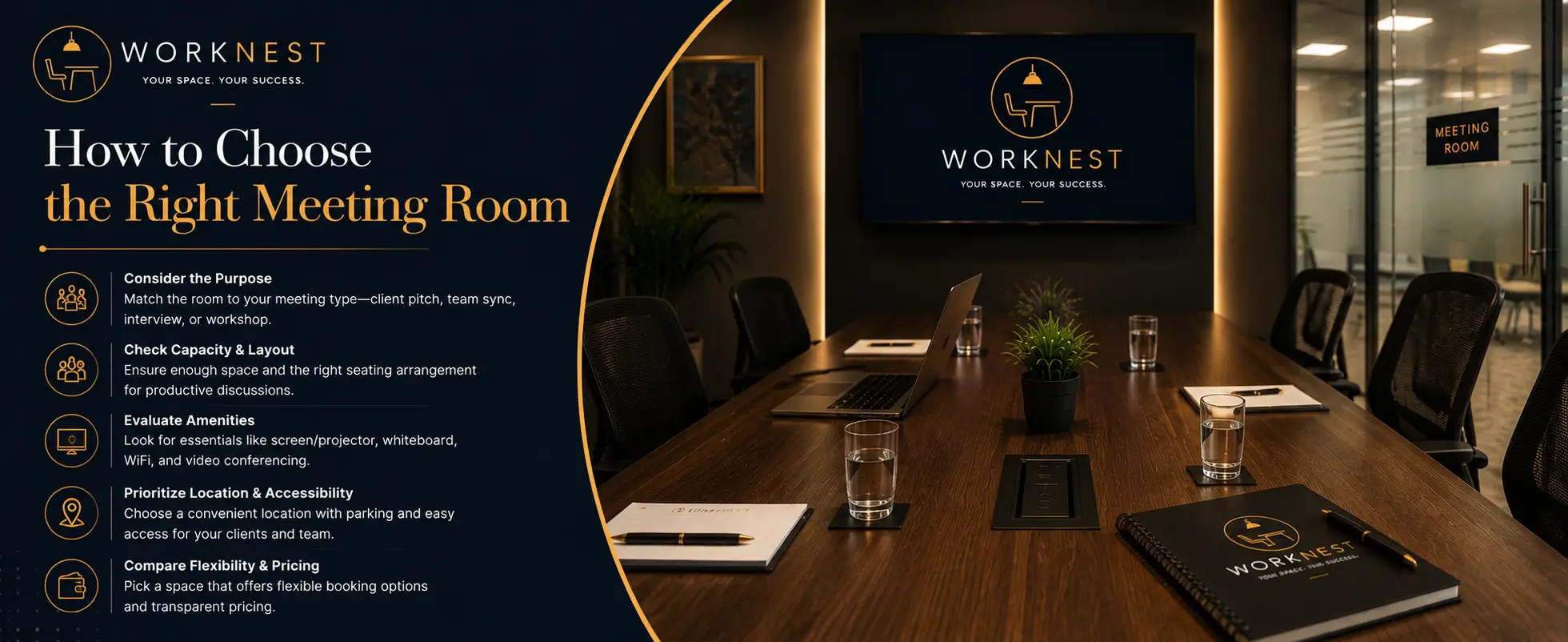
    Q5: Is a private cabin cheaper than renting a standalone office in Jaipur?

    Standalone serviced offices in Jaipur typically range from about ₹5,500 to ₹30,000 per month before furniture, deposit, and IT setup, and usually involve a 3–5 year lease. WorkNest’s flat ₹24,999/month bundles furniture, IT, maintenance, and member-rate meeting rooms into one fee with no long-term lock-in.

    Q6: Can a startup upgrade from a Dedicated Desk to a Private Cabin later?

    Yes. Members can move from a Dedicated Desk (₹9,999/month) to a Private Cabin as their team grows, without losing their membership or business address.

    Q7: Does the private cabin price change if I add more team members?

    No. Because it’s a flat rate, adding team members within the cabin’s capacity doesn’t increase the ₹24,999/month cost. This is the core advantage over per-seat billing.

    Q8: Where is WorkNest located, and how do I book a tour?

    WorkNest is at E-3, 6D Engineers Colony, Mansarovar, Jaipur 302020, a 20-minute walk from MI Road. Call +91 92564 22964 or email worknest.jaipur@gmail.com to book a free tour, confirmed within 30 minutes.